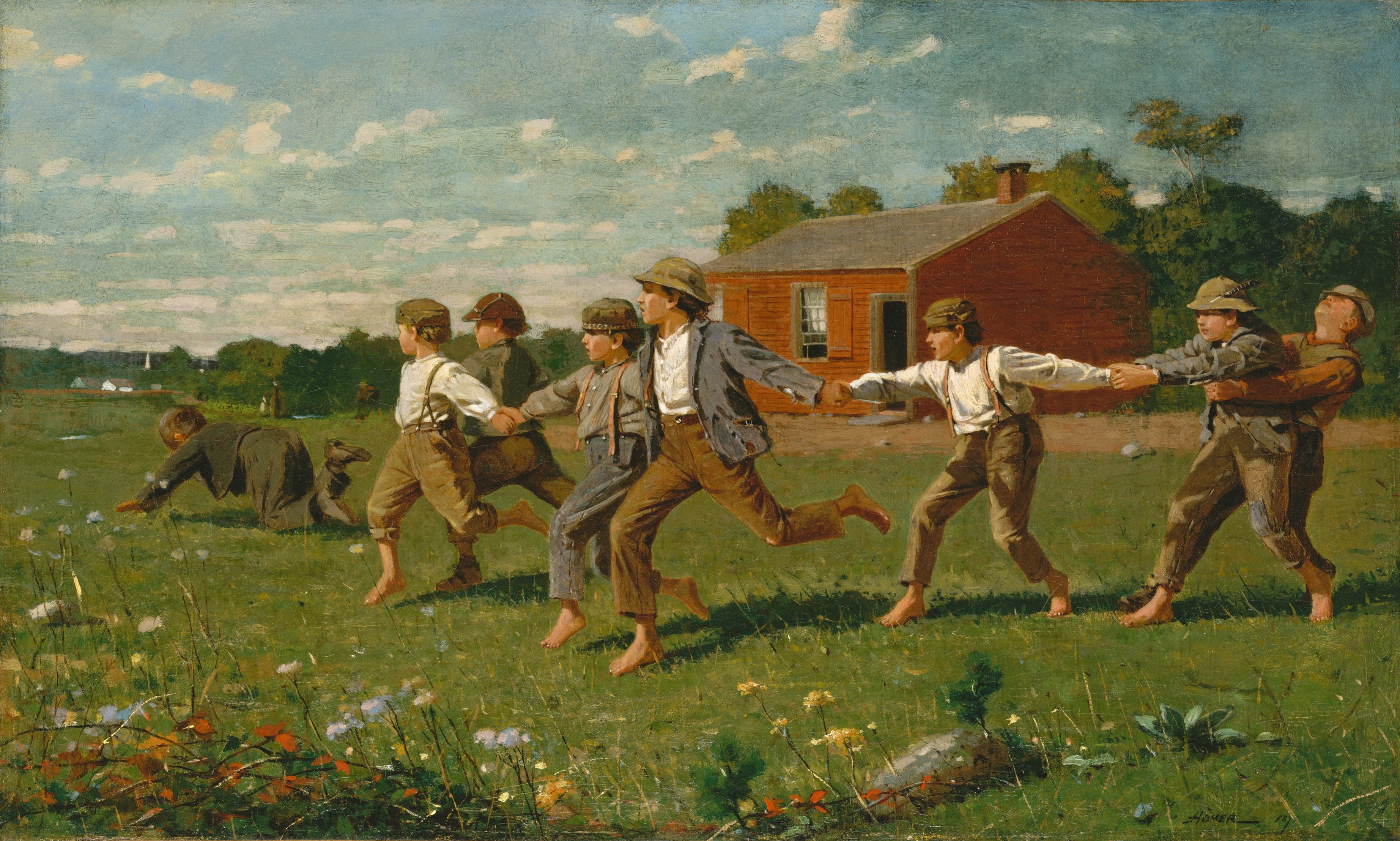
Winslow Homer » Snap the Whip » 1872 » Oil on canvas, 12 × 20 in (30.5 × 50.8 cm) » American Realism
The Metropolitan Museum of Art, New York, Gift of Christian A. Zabriskie, 1950
From the Goodie Collection · American Realism
Barefoot boys race across a summer field, hands locked in a long chain. The boys at one end dig in and swing the line around, and the boys at the other end go flying. One has already lost his grip. Behind them stands a little red schoolhouse, and above them, an enormous sky. Winslow Homer painted Snap the Whip in 1872, and it is one of the best-loved pictures of childhood in American art.
Homer painted two versions that year. The larger one, now at the Butler Institute of American Art in Ohio, sets the game against a wooded hillside. In this smaller version at the Metropolitan Museum, he took the hill away and opened the background to sky, so the scene could be almost any country school in America. Let’s take a closer look.
The game

Snap the whip, also called crack the whip, needs nothing but a field and a group of friends. Everyone holds hands in a line, the leader runs and turns sharply, and the swing travels down the chain like the crack of a whip. The child at the end moves fastest of all, and usually ends up in the grass. Look at the center of the line, where one boy’s hand grips the next. The whole game depends on holding on.
The anchor

At the right end, the biggest boys are doing the hardest work. One leans back with his head tipped to the sky, and the boy behind him hooks an arm around his waist. Their heels are planted in the grass. Every chain needs someone strong at the end to keep it from flying apart.
Who let go

On the left, the chain has already broken. The boy who was last in line is down on his hands and knees, scrambling to get back up. The Met reads this break in the chain as a quiet hint at the challenges ahead for a country still healing after the Civil War, when working together felt more important than ever.
Hold on tight, and the whole line can run. Let go, and you end up in the grass.
Bare feet in the grass

Not one of the boys wears shoes. Their feet are caught mid-stride, some lifted clear off the ground, with short shadows beneath them that suggest a high summer sun. Homer gives each boy his own pose, so the line seems to move from left to right as you look along it.
The little red schoolhouse

Behind the game stands a one-room schoolhouse with red clapboard walls, a brick chimney and an open door. Homer spent summers in the Hudson Valley in the early 1870s, and the building is thought to be based on a schoolhouse in Hurley, New York. You may recognize it from his painting School Time.

Look far off to the left, and you’ll find a tiny white church steeple and a few white houses. It is a whole village, painted in a few strokes, and a reminder that school and church were often the two centers of country life.
Wildflowers and a signature

Homer filled the foreground with wildflowers in red, white and lavender, painted with quick, loose touches. Then, in the grass at the lower right, he signed his name and the year: “HOMER 1872.”


From the Goodie Shop
Snap the Whip
Winslow Homer
$9 or 3+ for $8 each
- 5 × 7 in fine art print, horizontal, printed full bleed
- 230gsm matte fine art paper
- Free U.S. shipping
About the Painter
Winslow Homer (1836–1910)
Winslow Homer was born in Boston in 1836. He began his career as an apprentice to a lithographer and then as a freelance illustrator for magazines like Harper’s Weekly, which sent him to draw soldiers’ daily life during the Civil War.
After the war, he turned to scenes of everyday American life. In the early 1870s he spent summers in the Hudson Valley and painted country children at play: boys at recess in Snap the Whip, children arriving at a red schoolhouse in School Time, young people in the fields. In 1873, Harper’s Weekly published a wood engraving of Snap the Whip, and the image reached homes across the country.
Later, after a stay in the English fishing village of Cullercoats, he settled at Prouts Neck, on the coast of Maine, where he painted the powerful seascapes and watercolors that made him one of America’s greatest artists. He died there in 1910.
About the Genre
American Realism
American Realists painted the country as it was changing after the Civil War. Rather than heroic battles or idealized landscapes, they recorded small scenes of daily life that many people would recognize from their own childhood.
Homer’s pictures of children at play arrived just as Americans were moving from farms to cities. A game at recess outside a one-room school became a picture of a simpler time, and of a young country learning to pull together.
The Goodie Letter Club
New Art in Your Mailbox, Every Month
Snap the Whip was part of November’s Goodie Letter, A Seat at the Table. Join the club for a new letter, fresh art and a few surprises in your mailbox each month.
Free U.S. shipping. Cancel anytime.