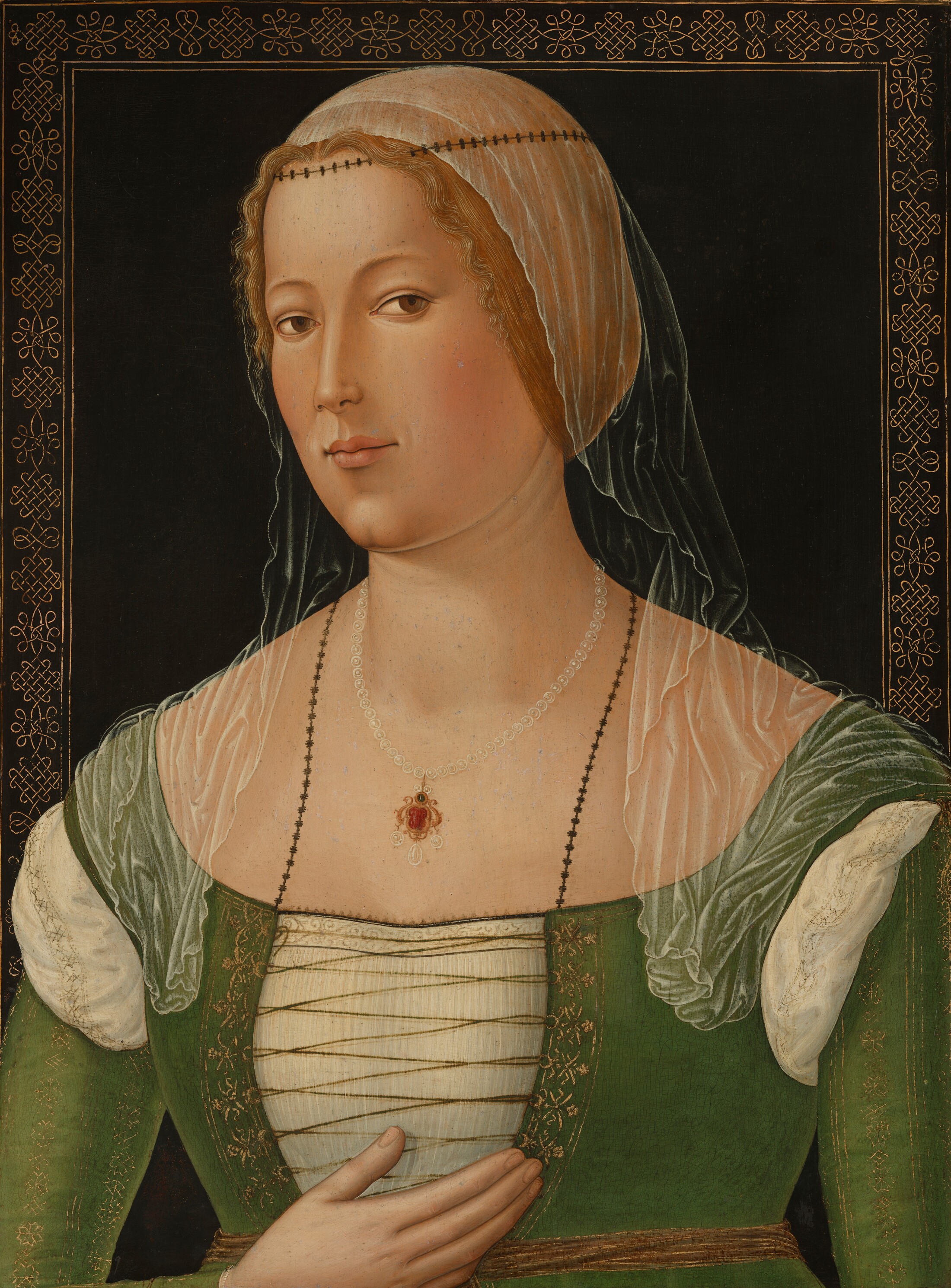
Girolamo di Benvenuto » Portrait of a Young Woman » c. 1508 » Oil on poplar panel, 22¾ × 17 in (58.1 × 43.2 cm) » Sienese Renaissance
National Gallery of Art, Washington, Samuel H. Kress Collection
From the Goodie Collection · Renaissance Portraiture
She glances at us from the corner of her eye, with the hint of a smile, as if she has just heard something amusing and is deciding whether to share it. For much of the nineteenth century, her owners believed she was Laura, the woman the poet Petrarch loved and wrote about for decades, painted by Simone Martini. Petrarch really did praise a portrait of Laura by Simone, which is how the legend began. But this panel was painted around 1508 in Siena, more than a century and a half later, by Girolamo di Benvenuto, and the young woman’s name has been lost.
What remains is a portrait of a young woman in her finest clothes and jewels, every pearl, lace and golden thread recorded with care. It is a painting made to be looked at closely.
A sideways glance

Her body turns slightly away, but her eyes slide back toward us. Look at the small details of her face: faint arched brows, the shallow dimples at the corners of her mouth, a little cleft in her chin. Her blond hair is gathered under a sheer veil, held in place by a thin band across her forehead studded with tiny dark ornaments, a fashionable touch for a young Italian woman around 1500.
Pearls and a jewel

Around her neck is a strand of pearls holding a gold pendant set with red and blue stones, with three more pearls dangling beneath it. Look closely and you’ll see a second, darker chain of tiny star-shaped links running down into her bodice. Pearls were linked with purity and were a common gift to brides, which has led some to wonder whether this portrait was made around the time of a marriage. We may never know.
The fashion of 1500

Her green gown shows exactly how fashionable Italians dressed at the time. Sleeves were often separate pieces, tied onto the bodice with laces, and the white linen chemise underneath was pulled through the gaps at the shoulder in soft puffs. Over everything falls the sheer veil, painted with fine white strokes so that you can see her shoulders and the green fabric right through it.
A portrait made to be looked at closely, every pearl, lace and golden thread recorded with care.
Laced in

At the front, her bodice is laced in a long zigzag over the white chemise, edged with bands of gold embroidery. Her right hand rests lightly against her chest, just over her heart. It is a quiet, graceful gesture, and it draws your eye back up the laces, past the jewel, to her face.
The golden frame

Finally, look at the edges. Around the black background runs a painted border of gold knotwork, intricate interlacing loops that look almost like embroidery. Then notice where it goes: the border disappears behind her shoulders, as if she were leaning forward, out of her frame and into our room.
About the Painter
Girolamo di Benvenuto (1470–1524)
Girolamo di Benvenuto was born in Siena in 1470 and spent his whole life there. His father, Benvenuto di Giovanni, was a respected Sienese painter, and Girolamo learned his craft in the family workshop, helping with frescoes and altarpieces before working on his own.
His first independent work, an Assumption of the Virgin painted in 1498 for the town of Montalcino, is still there today. His best-known painting, the Madonna of the Snow, is signed and dated 1508, the same year as this portrait, and hangs in the Pinacoteca Nazionale in Siena.
Most of his paintings were religious, but he also made pictures for private homes, including decorated wedding chests and a round Judgment of Paris meant for a bedroom, now in the Louvre. He died in Siena in 1524. This portrait, once mistaken for Petrarch’s Laura, is now one of the most admired works attributed to him.
About the Genre
Renaissance Portraiture
During the Italian Renaissance, portraits of individual people became far more common. Painters studied real faces closely, and families commissioned likenesses to mark marriages, honor loved ones or show their place in society.
Girolamo di Benvenuto worked in Siena, a city known for its graceful, refined style. Renaissance portraits like this one use carefully painted clothing, jewelry and setting to hint at who the sitter was and the world she lived in.

From the Goodie Letter
Art That Arrives in Your Mailbox
Portrait of a Young Woman is the featured artwork in December’s Holiday Edition, tucked in with a letter, a fine-art print and a few surprises.
Free U.S. shipping. Cancel anytime.
Image: Girolamo di Benvenuto, Portrait of a Young Woman, c. 1508. National Gallery of Art, Washington, Samuel H. Kress Collection 1939.1.353. Open access.