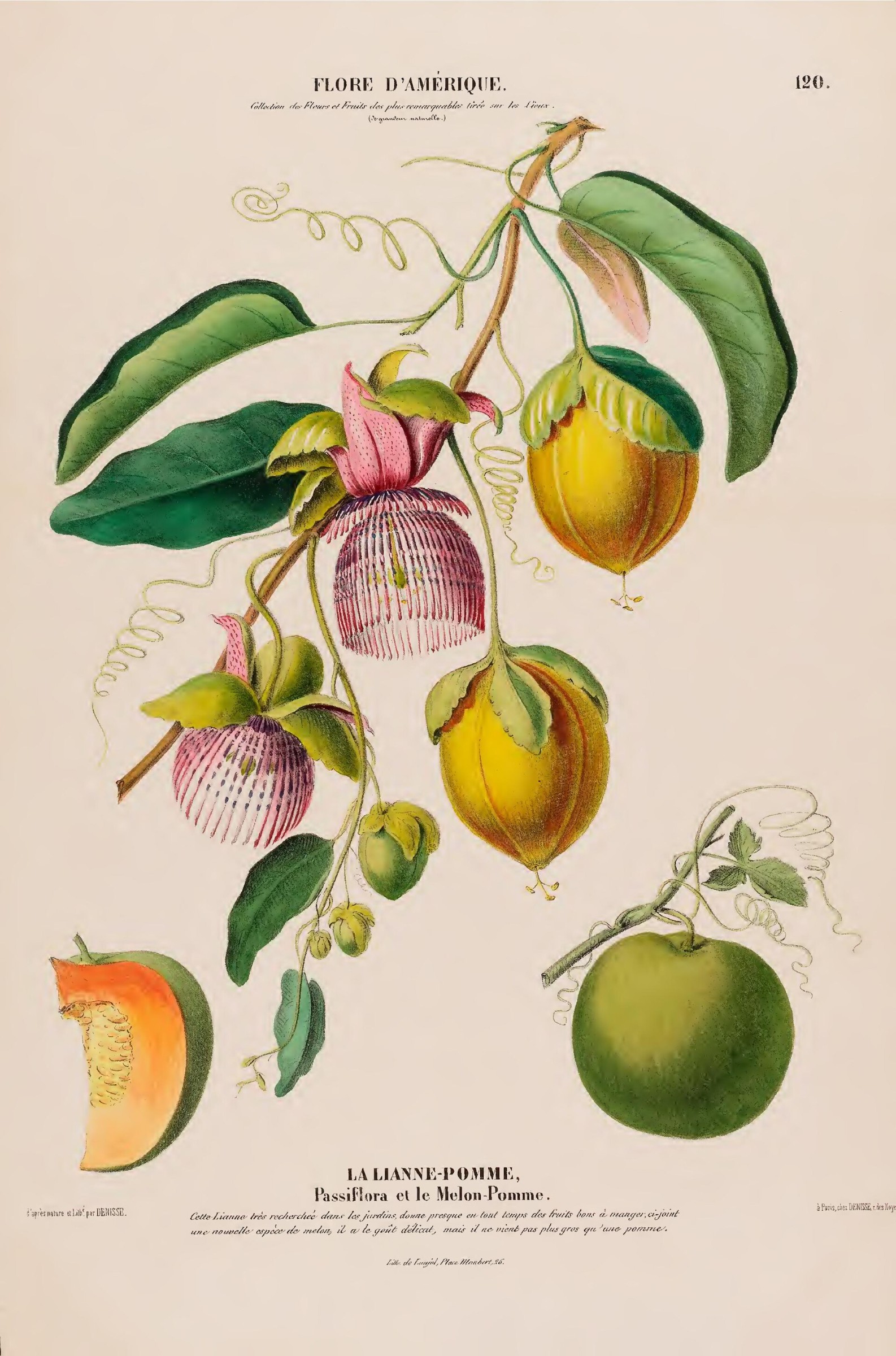
Étienne Denisse » La Lianne-Pomme, Passiflora et le Melon-Pomme, plate 120 from Flore d’Amérique » 1843–1846 » Hand-colored lithograph » Botanical Illustration
Published in Paris by Gihaut. New York Botanical Garden, LuEsther T. Mertz Library
From the Goodie Collection · Botanical Illustration
A vine curls across the page, hung with frilly pink flowers and plump golden fruit. Below it sit a wedge of orange melon and a small green melon on its stem. This is plate 120 from Flore d’Amérique, a book of the plants of the Caribbean drawn from life by the French artist Étienne Denisse.
Denisse spent many years in the French Antilles, the French islands of the Caribbean, recording plants that were eaten, grown in gardens or used as medicine. Back in Paris, his drawings became lithographs, printed in black and then colored by hand, and the book was published in the 1840s.
The passionflower

The flower is a passionflower, with a skirt of thin, striped filaments hanging beneath its petals. Denisse colored each one in pink and purple, and the effect is almost like lace. Passionflowers are native to the Americas, and European visitors were fascinated by their strange, intricate shape.
The golden fruit

The plant’s French name, lianne-pomme, means something like “vine apple.” The caption calls it a vine much sought after for gardens, one that gives good fruit to eat almost all year round. Its golden fruits hang cupped in green leaves, like little lanterns.
A garden vine that gives good fruit almost all year round.
Curling tendrils

Look for the corkscrew tendrils winding out from the stem. Passionflower vines use them to grab hold of branches and fences as they climb. Botanical artists included details like these on purpose, because they help identify a plant as surely as its flowers do.
The melon-apple

At the bottom of the page, Denisse adds a second plant: the melon-pomme, or “apple melon.” He shows it cut open so we can see the orange flesh and pale seeds inside. His caption calls it a new kind of melon with a delicate taste that grows no bigger than an apple.
No bigger than an apple

On the right, the whole melon hangs from its own little vine, round and green like an apple. Pairing it with the passionflower was practical as well as pretty: both were garden plants with fruit worth eating, exactly the kind of thing the book’s readers wanted to know about.
Words and picture together

Below the picture, the title and a few lines of French describe the plants, and small print in the corner credits Denisse with drawing the plate from nature and making the lithograph. Text and image were meant to work together, like a field guide you could also frame.
About the Artist
Étienne Denisse (1785–1861)
Étienne Denisse was born in 1785 in Carcassonne, in the south of France. He was a botanist, gardener and artist, and he worked for a time at the gardens of the National Museum of Natural History in Paris.
He lived for many years in the French West Indies, where the government of Guadeloupe commissioned him to draw and collect the islands’ plants and to record how they were used for food and medicine. That careful study became Flore d’Amérique, admired today for its rich hand-colored plates. He died in 1861.
About the Genre
Botanical Illustration
Botanical illustration is the art of drawing plants so accurately that someone could identify them. Long before photography, explorers, doctors and gardeners relied on these pictures to learn which plants were useful, which were safe to eat and how they grew.
The best botanical artists combined scientific care with real beauty. They often showed a plant at several stages at once, with flowers, fruit and a cut section side by side, just as Denisse does here with the passionflower and the little melon.

From the Goodie Letter
Art That Arrives in Your Mailbox
La Lianne-Pomme was part of June’s Goodie Letter. Each month brings new art, tucked in with a letter, a fine-art print and a few surprises.
Free U.S. shipping. Cancel anytime.
Image: Étienne Denisse, La Lianne-Pomme, Passiflora et le Melon-Pomme, plate 120 from Flore d’Amérique, Paris: Gihaut, 1843–1846. New York Botanical Garden, LuEsther T. Mertz Library, via the Internet Archive. Public domain.