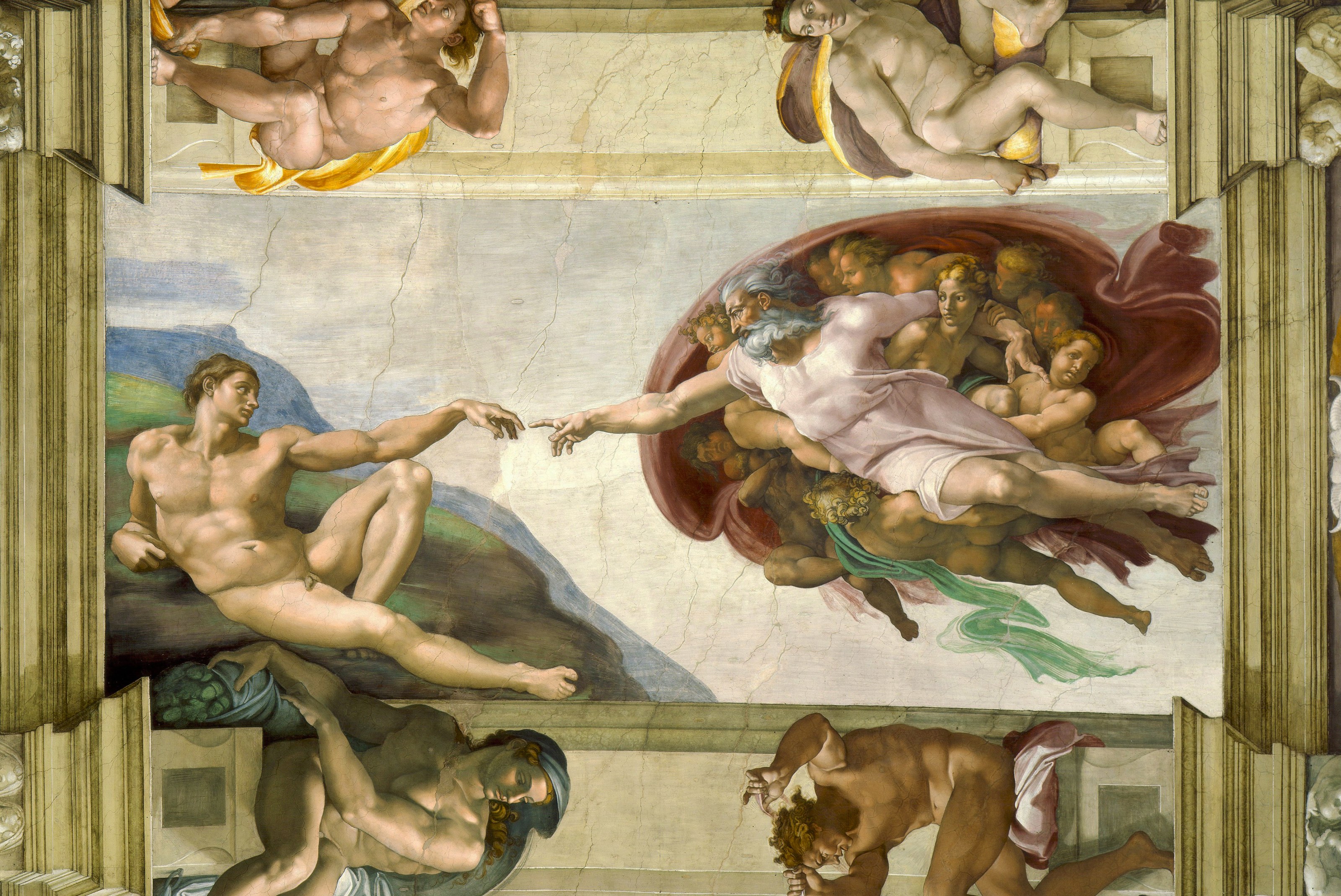
Michelangelo Buonarroti » La creazione di Adamo (The Creation of Adam) » c. 1511–1512 » Fresco » Italian High Renaissance
Sistine Chapel ceiling, Vatican City
From the Goodie Collection · High Renaissance
It may be the most copied image in the history of art, printed on posters, mugs and greeting cards, and borrowed by everyone from advertisers to filmmakers. But the real thing is painted on a ceiling twenty meters above the floor of the Sistine Chapel, and most visitors see it with their heads tipped back, for a few minutes, in a crowd. It rewards a much closer look.
Michelangelo did not want the job. He thought of himself as a sculptor, not a painter, and when Pope Julius II asked him to decorate the chapel ceiling in 1508, he tried to talk his way out of it. Over the next four years he painted more than three hundred figures across the vault, working on scaffolding he designed himself, standing with his head bent back. He even wrote a poem complaining about it, with a little sketch of himself painting overhead. The Creation of Adam, painted around 1511 and 1512, is one of nine scenes from the Book of Genesis that run down the center of the ceiling.
The space between

Everyone remembers the hands, but look at how differently they are drawn. God’s arm is fully extended, his index finger straight and intent. Adam’s hand droops from the wrist, the finger slightly curled, as if he hasn’t quite woken up. The two never touch. Michelangelo left a sliver of empty plaster between them, and that small gap is what makes the whole scene feel alive: the moment just before.
Look closely and you can also see fine cracks running through the plaster around the fingertips, a reminder that this is a fresco, painted into wet plaster on a curved ceiling five hundred years ago.
Adam, half awake

Adam reclines on a bare green slope, his body perfectly formed but strangely relaxed, as if he has the shape of a man but not yet the spark. His face turns toward God with a look that is calm, curious and a little dreamy. Michelangelo, the sculptor, gives him the weight and muscle of a marble statue, then lets him lean back like someone resting on a summer hill.
A God in motion

On the other side, everything is movement. God sweeps in from the right, his white hair and beard pushed back as if by wind, his pale robe pulled tight against his body. This is not a distant king on a throne but a figure in flight, leaning forward with his whole body. Notice the small angel tucked under his arm, peering out at the scene.
The two never touch. That small gap is what makes the whole scene feel alive.
Who is she?

Tucked beneath God’s left arm, among the angels, a young woman with wide eyes stares across the gap at Adam. She is easy to miss and impossible to forget once you see her. Some scholars believe she is Eve, waiting to be created; others see the Virgin Mary, or Sophia, the figure of divine Wisdom. Michelangelo never explained, and five centuries later the question is still open.
A cloak shaped like a brain

Step back and look at the shape surrounding God: a billowing red cloak filled with angels. In 1990, an American physician named Frank Lynn Meshberger published an article in the Journal of the American Medical Association arguing that its outline closely matches a cross-section of the human brain, complete with folds and a curving stem. Michelangelo did study anatomy and dissected bodies as a young man, so the idea is tempting: God giving Adam not just life, but intelligence. Whether it was intentional, no one can say.
Cleaned and brightened
For centuries, the ceiling looked dark and brownish, dimmed by candle smoke and old varnish. A long restoration, completed in the 1990s, cleaned it and revealed the clear, bright colors you see here: the pale blues, soft greens and that rich red cloak. The next time you see the image on a mug or a poster, picture it where it belongs, glowing on a ceiling, high above a quiet room.
About the Painter
Michelangelo Buonarroti (1475–1564)
Michelangelo was born in 1475 in the small Tuscan town of Caprese and grew up in Florence. As a boy he trained in the workshop of the painter Domenico Ghirlandaio, then caught the eye of Lorenzo de’ Medici, who brought the teenager into his household to study the family’s collection of ancient sculpture.
Sculpture was always his first love. By his mid-twenties he had carved the Pietà in Saint Peter’s, and soon after the towering David in Florence. Painting the Sistine Chapel ceiling from 1508 to 1512 was a commission he accepted reluctantly, yet it became one of the most famous works of art in the world. Decades later he returned to the chapel to paint the vast Last Judgment on the altar wall.
He was also a poet and an architect, designing the great dome of Saint Peter’s Basilica in his old age. He was so celebrated that two biographies of him were published while he was still alive, a first for any artist, and admirers called him Il Divino, “the divine one.”
Michelangelo died in Rome in 1564, at eighty-eight. His body was carried back to Florence, the city he considered home, and buried in the church of Santa Croce.
About the Genre
The High Renaissance
The High Renaissance, from about 1490 to 1530, was a brief golden age centered in Rome and Florence. Leonardo, Raphael and Michelangelo brought together everything artists had learned about anatomy, perspective and ancient art, aiming for harmony and ideal beauty.
The Sistine Chapel ceiling is one of its crowning works. Michelangelo painted it in fresco, brushing pigment into wet plaster while standing on scaffolding high above the floor, and his powerful, sculptural bodies reflect his first love, which was sculpture.

From the Goodie Letter
Art That Arrives in Your Mailbox
The Creation of Adam is December’s postcard, tucked in with a letter, a fine-art print and a few surprises.
Free U.S. shipping. Cancel anytime.
Image: Michelangelo, The Creation of Adam, c. 1511–1512. Fresco, Sistine Chapel, Vatican City. Public domain, via Wikimedia Commons.