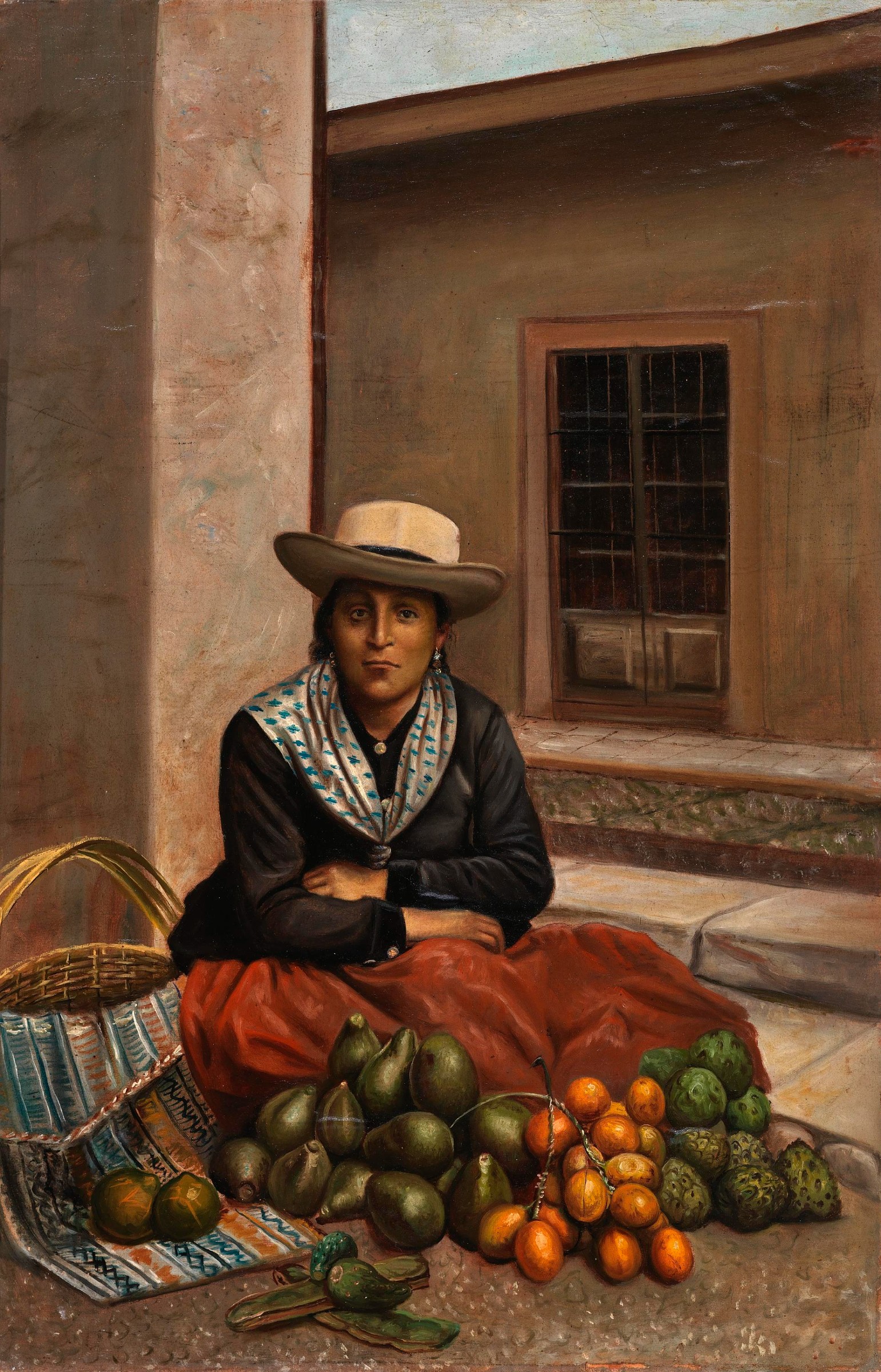
Unidentified artist » Lima Woman » about 1890–1892 » Oil on canvas, 31½ × 20½ in (80 × 52.1 cm) » Latin American Art
Smithsonian American Art Museum, Washington, D.C., Museum purchase
From the Goodie Collection · Latin American Art
A woman sits on a stone step in a quiet street, arms folded, looking straight back at us. Spread on the ground in front of her is everything she has come to sell: glossy avocados, bright orange fruit still on the branch, green cherimoyas and a basket resting on a striped cloth.
The painting is known as Lima Woman, and it was made around 1890 in Lima, the capital of Peru. No one knows who painted it. But the artist clearly took time with this woman and her wares, and gave her a steady, direct gaze that is hard to forget.
The white hat

Her pale, wide-brimmed hat frames her face and shades her eyes. Hats like this were everyday wear for women who worked outdoors in Lima’s streets and markets. Notice the small earrings, and the soft light the artist uses to model her face.
A patterned scarf

Around her shoulders she wears a pale scarf patterned in blue, tucked over a dark jacket. Below, a full red skirt spreads across the step. These bright touches against the plain stone wall are what make the whole painting glow.
Avocados and orange fruit

Avocados, called paltas in Peru, have been grown there since ancient times. Beside them hang clusters of small orange fruits still on their stems, a sign they were freshly picked. Look at how each avocado catches a little highlight of light.
Everything she has come to sell, laid out at her feet.
Cherimoyas

On the right are cherimoyas, green fruits patterned with what look like overlapping scales. Cherimoyas are native to the Andes, and their soft, sweet white flesh is often compared to custard, which is why they are sometimes called custard apples.
The basket and the cloth

Beside her sits a woven basket on a striped cloth with a zigzag border. Textiles like this have a long history in Peru and were part of daily life, used for carrying and wrapping goods. A few more fruits rest in front of it.
A window onto the street

Behind her, a wooden window with iron bars is set into a thick stucco wall above a low stone step. The setting is simple, but it places her firmly in a real street in the city rather than in a painter’s studio.
About the Painter
An Unknown Artist
The Smithsonian American Art Museum lists the artist of Lima Woman as unidentified, possibly South American, and dates the painting to about 1890 to 1892. Many fine paintings come down to us without a name attached, and this is one of them.
Pictures of street sellers and local characters were much loved in Lima in the 1800s. Earlier in the century, the watercolorist Pancho Fierro became famous for his lively scenes of the city’s vendors and everyday people, and later painters kept that tradition alive.
About the Genre
Latin American Art
Latin American art spans thousands of years, from ancient textiles and pottery to colonial church paintings and the bold murals of the twentieth century. In the 1800s, as many countries in the region became independent, artists turned more and more to their own people and places for subjects.
One popular approach was costumbrismo, the art of everyday customs: market sellers, street scenes, local dress and food. Lima Woman shares that spirit, recording the clothes, the fruit and the streets of one Peruvian city with care.

From the Goodie Letter
Art That Arrives in Your Mailbox
Lima Woman was part of June’s Goodie Letter. Each month brings new art, tucked in with a letter, a fine-art print and a few surprises.
Free U.S. shipping. Cancel anytime.
Image: Unidentified artist, Lima Woman, about 1890–1892. Smithsonian American Art Museum, Museum purchase (1985.66.164,674). Public domain (CC0).