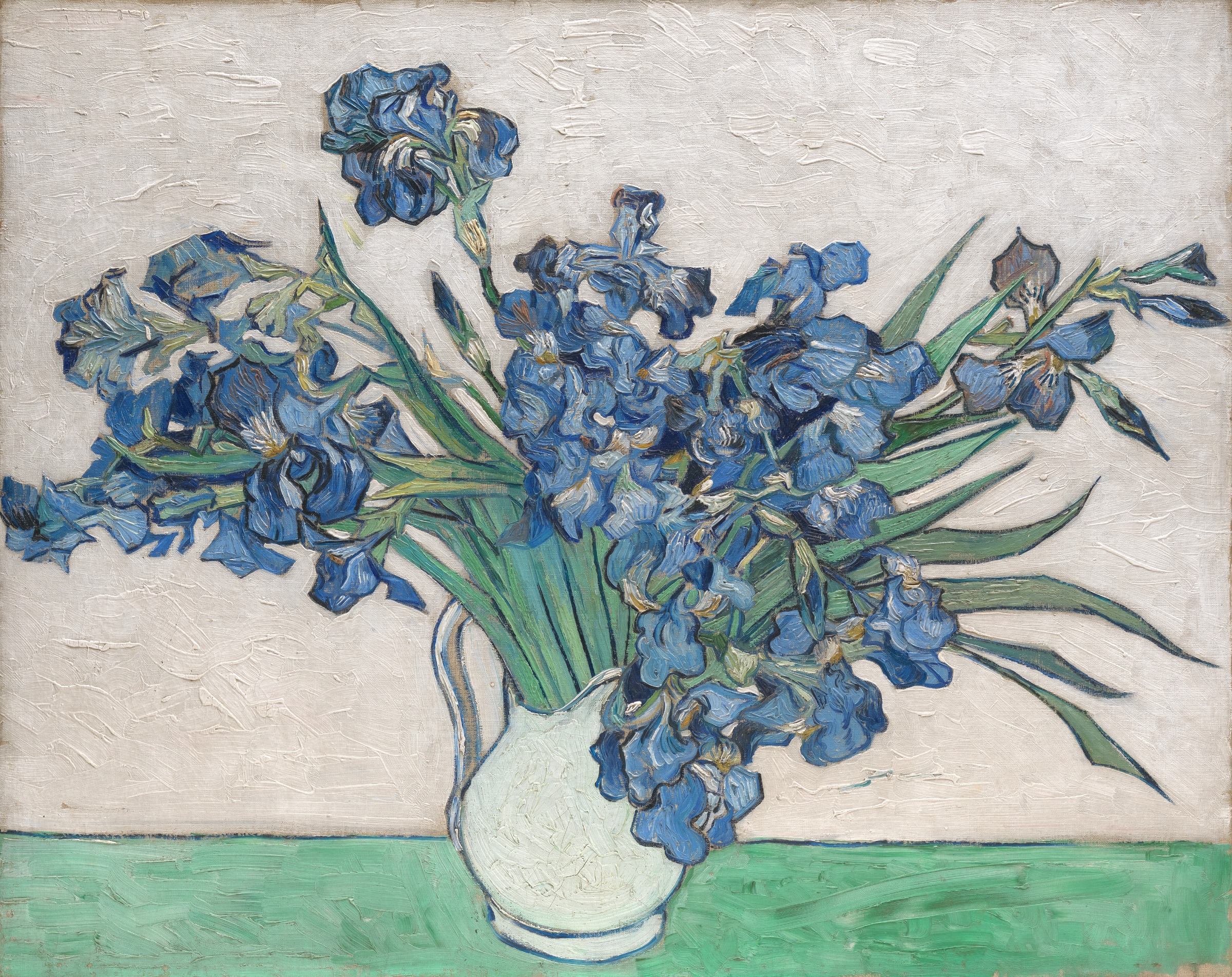
Vincent van Gogh » Irises » 1890 » Oil on canvas, 29 × 36¼ in (73.7 × 92.1 cm) » Post-Impressionism
The Metropolitan Museum of Art, New York, Gift of Adele R. Levy, 1958
From the Goodie Collection · Post-Impressionism
A plain white jug can barely hold them: dozens of blue irises spill out in every direction, their long green leaves reaching for the edges of the canvas. Vincent van Gogh painted this bouquet in May 1890, in the spring garden of the asylum at Saint-Rémy in the south of France, just days before he left for the north.
It was one of two still lifes of irises he made that month. In a letter to his brother Theo, he described the idea behind this one: violet flowers against a pink background, so the opposite colors would make each other sing. But look again. The irises are blue and the wall is almost white. Time has changed this painting, and that’s part of its story. Let’s take a closer look.
The iris on its own

At the top, one iris has broken away from the crowd, standing on its own long stem. Notice the dark outlines around each petal, like the lines in a Japanese woodblock print. Van Gogh collected those prints and loved their bold contours and flat areas of color.
A hint of the original violet

Here is the secret. Van Gogh mixed his violets using a red pigment that fades in light. Over the years the red disappeared, leaving the flowers blue and turning the pink wall nearly white. In a few places, like this iris at the far right, you can still see a trace of the warm, reddish violet he intended.
Leaves like brushstrokes

The leaves sweep out to the right in long, curving strokes, each one painted in a single confident movement and edged in dark blue. They give the whole bouquet a sense of movement, as if a breeze has just passed through.
Painted in May 1890, a bouquet so full the jug can barely hold it.
The white jug

The jug is painted in thick, swirling strokes of white and pale green, its handle outlined in blue. Up close you can see how heavily he applied the paint, a technique called impasto, so the surface catches the light like plaster.
Where the wall meets the table

The setting couldn’t be simpler: a pale wall, a green tabletop and one thin blue line between them. Van Gogh didn’t need anything more. The flowers do all the talking.
Tumbling over the edge

On the left, the irises seem to tumble right out of the picture, some drooping, some already past their best. It’s a full, generous, slightly unruly bouquet, painted by someone who saw flowers as full of life.
About the Painter
Vincent van Gogh (1853–1890)
Vincent van Gogh was born in 1853 in Zundert, a village in the Netherlands. Before he became an artist he worked as an art dealer, a teacher and a preacher, and he didn’t begin painting seriously until he was 27.
In 1886 he moved to Paris to live with his younger brother Theo, an art dealer who supported him throughout his life. There his dark palette turned bright under the influence of the Impressionists and Japanese prints. In 1888 he moved to Arles in the south of France, chasing the sunlight, and the following year he entered the asylum at Saint-Rémy, where he painted some of his best-loved works, including The Starry Night and his irises.
In just about ten years he made around 900 paintings. He died in Auvers-sur-Oise, near Paris, in July 1890, at 37. His letters to Theo, hundreds of them, are still read today as some of the most moving writing ever made by an artist.
About the Genre
Post-Impressionism
Post-Impressionism is the name given to artists who came after the Impressionists in the 1880s and 1890s. They loved the bright color of Impressionism but wanted something more: stronger shapes, deeper feeling and a more personal way of seeing.
Each went their own way. Cézanne built pictures out of solid patches of color, Gauguin used flat, dreamlike color, and Van Gogh used thick, swirling paint and bold outlines to show emotion. In Irises you can see it in the heavy ridges of paint and the dark lines around each petal.

From the Goodie Letter
Art That Arrives in Your Mailbox
Irises was the greeting card tucked into May’s Goodie Letter, ready to send to someone you love. Each month brings new art, tucked in with a letter, a fine-art print and a few surprises.
Free U.S. shipping. Cancel anytime.
Image: Vincent van Gogh, Irises, 1890. The Metropolitan Museum of Art, New York, Gift of Adele R. Levy, 1958 (58.187). Open access.