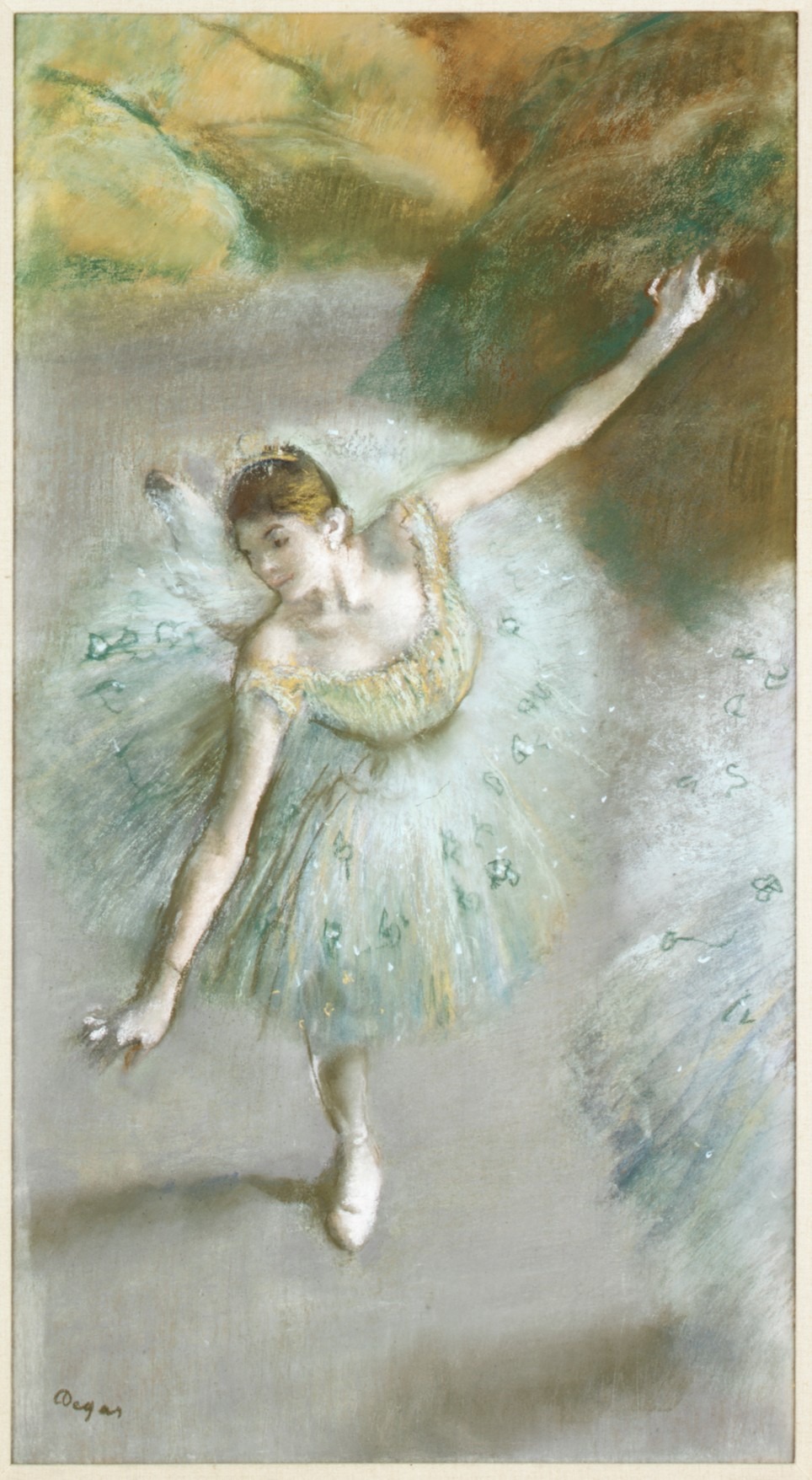
Edgar Degas » Dancer in Green » c. 1883 » Pastel, 28 × 15 in (71 × 37.9 cm) » Impressionism
The Metropolitan Museum of Art, New York, Bequest of Joan Whitney Payson, 1975
From the Goodie Collection · Impressionism
A ballerina leans into a turn, one arm flung up toward the scenery, the other reaching down toward the stage. Her green-and-white tutu blurs like a cloud. Edgar Degas made this drawing in pastel around 1883, and it feels like a single heartbeat of a performance.
We seem to be looking down at her from high above, perhaps from one of the theater’s boxes beside the stage. Degas loved these unusual viewpoints. He went to the Paris Opéra again and again, and dancers became his favorite subject: more than half of all his works show them. Let’s take a closer look.
A tilted head

Her head tilts gently down and to the side, eyes lowered, a small gold ornament catching the stage lights in her hair. Degas doesn’t paint a portrait of a particular dancer. He captures a mood: concentration, grace and a little bit of fatigue.
Reaching for the scenery

Her right arm sweeps up and back, her fingers almost touching the painted scenery behind her. The long diagonal line of her arm gives the whole picture its energy, pulling our eye from corner to corner.
A cloud of tulle

The tutu is made of soft layers of white, pale blue and green pastel, scattered with tiny green bows and flecks of light. Pastel was perfect for this: powdery sticks of pure color that he could rub, layer and smudge to make fabric look weightless and full of air.
One heartbeat of a performance, caught in powdery pastel.
On pointe

Look down to her feet. She balances on the very tip of one satin slipper, on pointe, while her shadow stretches across the gray stage floor. All that lightness rests on one small point.
Dancers rushing past

At the right edge, more swirls of tulle and green bows slip into the frame: other dancers, moving so fast they’re only a blur. Degas often cropped his scenes like this, cutting figures off at the edges the way a camera might.
The painted backdrop

Behind her, the stage scenery is painted in loose strokes of ochre, gold and green, trees or rocks we can’t quite make out. And down in the lower left corner, quietly, he signed his name: “Degas.”

From the Goodie Shop
Dancer in Green
Edgar Degas
$9 or 3+ for $8 each
- 5 × 7 in fine art print, vertical, printed full bleed
- 230gsm matte fine art paper
- Free U.S. shipping
About the Painter
Edgar Degas (1834–1917)
Edgar Degas was born in Paris in 1834 into a wealthy banking family. He studied at the École des Beaux-Arts and spent several years in Italy copying the old masters. He deeply admired the painter Ingres, and drawing was always at the heart of his art.
Degas helped organize the Impressionist exhibitions of the 1870s and 1880s and showed his work in nearly all of them, though he preferred to call himself a realist. Instead of painting outdoors, he watched modern Paris: racetracks, cafés, laundresses, milliners and, above all, ballet dancers at the Paris Opéra.
As his eyesight weakened in later life, he turned more and more to pastel and sculpture, including his famous Little Dancer Aged Fourteen. He died in Paris in 1917.
About the Genre
Impressionism
Impressionism began in Paris in the 1870s, when a group of young painters grew tired of the polished, story-telling pictures favored by the official art world. They wanted to paint modern life as it really looked: city streets, cafés, gardens and theaters, caught in a passing moment.
They worked with quick, visible brushstrokes and fresh, bright color, and cared more about light and movement than fine detail. Degas preferred to call himself a realist, but he showed his work in the Impressionist exhibitions, and his dancers, glimpsed mid-step from unusual angles, capture exactly that fleeting feeling.
The Goodie Letter Club
New Art in Your Mailbox, Every Month
Dancer in Green was the fine art print in May’s Goodie Letter. Join the club for a new letter, fresh art and a few surprises in your mailbox each month.
Free U.S. shipping. Cancel anytime.
Image: Edgar Degas, Dancer in Green, c. 1883. The Metropolitan Museum of Art, New York, Bequest of Joan Whitney Payson, 1975 (1976.201.7). Open access.