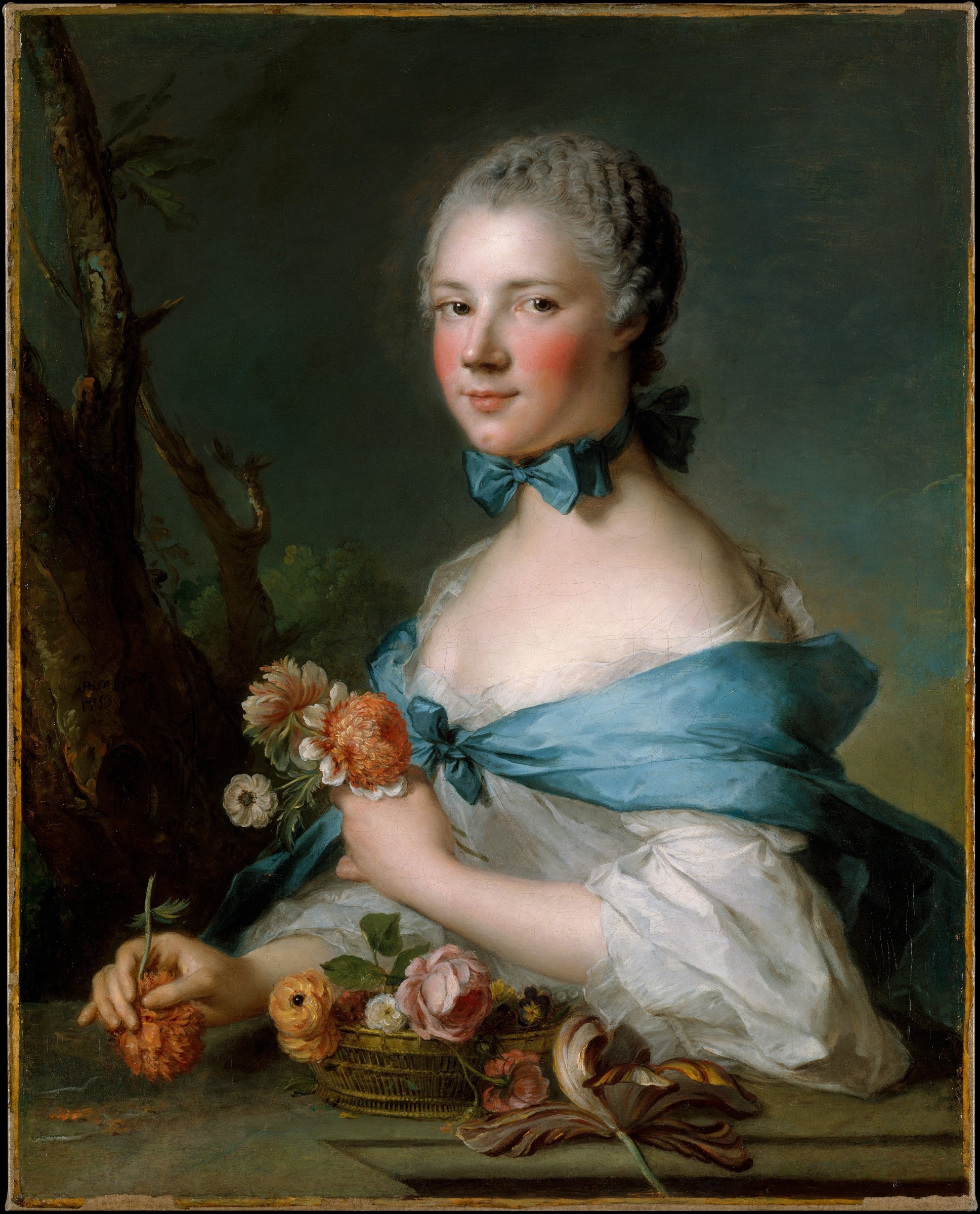
Jean-Marc Nattier » Portrait of a Woman » 1753 » Oil on canvas, 31½ × 25¼ in (80 × 64.1 cm) » 18th Century
The Metropolitan Museum of Art, New York, The Jack and Belle Linsky Collection, 1982
From the Goodie Collection · Rococo Portraiture
A young woman turns to meet our eyes with a small, knowing smile. She sits beside a stone ledge with a basket of fresh flowers, a bouquet in one hand and a single bloom in the other, wrapped in white silk and sky-blue satin. The French painter Jean-Marc Nattier signed and dated her portrait on the tree trunk behind her in 1753.
For years she was thought to be the Marquise Perrin de Cypierre, a lady of the French nobility, but today her name is no longer certain, so the museum calls her simply Portrait of a Woman. What we do know is that Nattier was the favorite portrait painter of the court of Louis XV, and that this is everything a fashionable Parisian lady of the 1750s wanted to look like. Let’s take a closer look.
Powder and rouge

Her hair is dressed close to the head in tight little rows of curls, a style the French nicknamed the tête de mouton, or “sheep’s head,” and dusted with powder to give it that soft, silvery gray. Her cheeks wear two round patches of rouge. At the French court, bold rouge wasn’t meant to look natural at all. It was part of a lady’s formal dress, a sign of rank as much as beauty.
A ribbon at her throat

A blue silk ribbon is tied snugly around her neck in a crisp bow, framing her face and drawing our eye down to her bare shoulders. Conservators have found faint earlier outlines under the paint, called pentimenti, showing that Nattier moved the ribbon and her hair while he worked to get them just right.
Flowers in her hand

She holds a small bouquet at her chest: ruffled orange blooms and a white anemone with a dark center. Nattier loved to paint society ladies as goddesses from Greek and Roman myths, and flowers belonged to Flora, the goddess of spring. Here there are no costumes or clouds, just a lady and her flowers, but the gentle hint is still there.

With her other hand she lifts a single flower by its stem, as if she’s choosing which one to add next. Look at how softly Nattier paints her fingers, with the same rosy warmth as her cheeks.
A portrait of summer in full bloom, painted for a lady of the French court.
A basket from the garden

In front of her sits a little woven basket spilling over with garden flowers: a full pink rose, a yellow ranunculus, small white blossoms and dark, velvety pansies. Each flower is painted with quick, confident strokes that look almost real from a few steps back.
The fallen tulip

And lying on the ledge is a striped tulip, its petals flung open as tulips do at the very end of their bloom. Flowers in paintings often carry a quiet message: beauty is fleeting, so enjoy it while it’s here. It’s a lovely thought to hold onto in the middle of summer.

From the Goodie Shop
Portrait of a Woman with Flowers
Jean-Marc Nattier
$9 or 3+ for $8 each
- 5 × 7 in fine art print, vertical, printed full bleed
- 230gsm matte fine art paper
- Free U.S. shipping
About the Painter
Jean-Marc Nattier (1685–1766)
Jean-Marc Nattier was born in Paris in 1685 into a family of artists. His father was a portrait painter and his mother a miniaturist. As a young man he made drawings of Peter Paul Rubens’s famous paintings of Marie de’ Medici at the Luxembourg Palace so they could be turned into engravings, and he was invited to Amsterdam to paint the Russian tsar, Peter the Great.
After losing much of his savings in a financial crash in 1720, Nattier turned to portraits to make a living, and found his calling. He became famous for painting the ladies of the French court as mythological figures, such as Diana, Flora and Hebe, with pale skin, rosy cheeks and soft, glowing fabrics. He became the official painter to the daughters of King Louis XV.
He loved a particular soft, silvery blue so much that the color is still known as “Nattier blue.” By the 1760s tastes had changed and his style fell out of fashion. He died in Paris in 1766.
About the Genre
Rococo Portraiture
Rococo was the light, playful style that swept through France in the early 1700s. After the grand, serious art of Louis XIV’s court, painters turned to soft pastel colors, graceful curves and charming scenes of love, leisure and nature.
In portraits, Rococo artists flattered their sitters with smooth, glowing skin, silky fabrics and sweet expressions. Nattier, a favorite of the French royal court, often dressed women as goddesses or surrounded them with flowers, turning a likeness into something closer to a daydream.
The Goodie Letter Club
New Art in Your Mailbox, Every Month
This portrait lined the envelope in July’s Goodie Letter, Growing Through the Season You’re In, a surprise waiting under the flap. Join the club for a new letter, fresh art and a few surprises in your mailbox each month.
Free U.S. shipping. Cancel anytime.