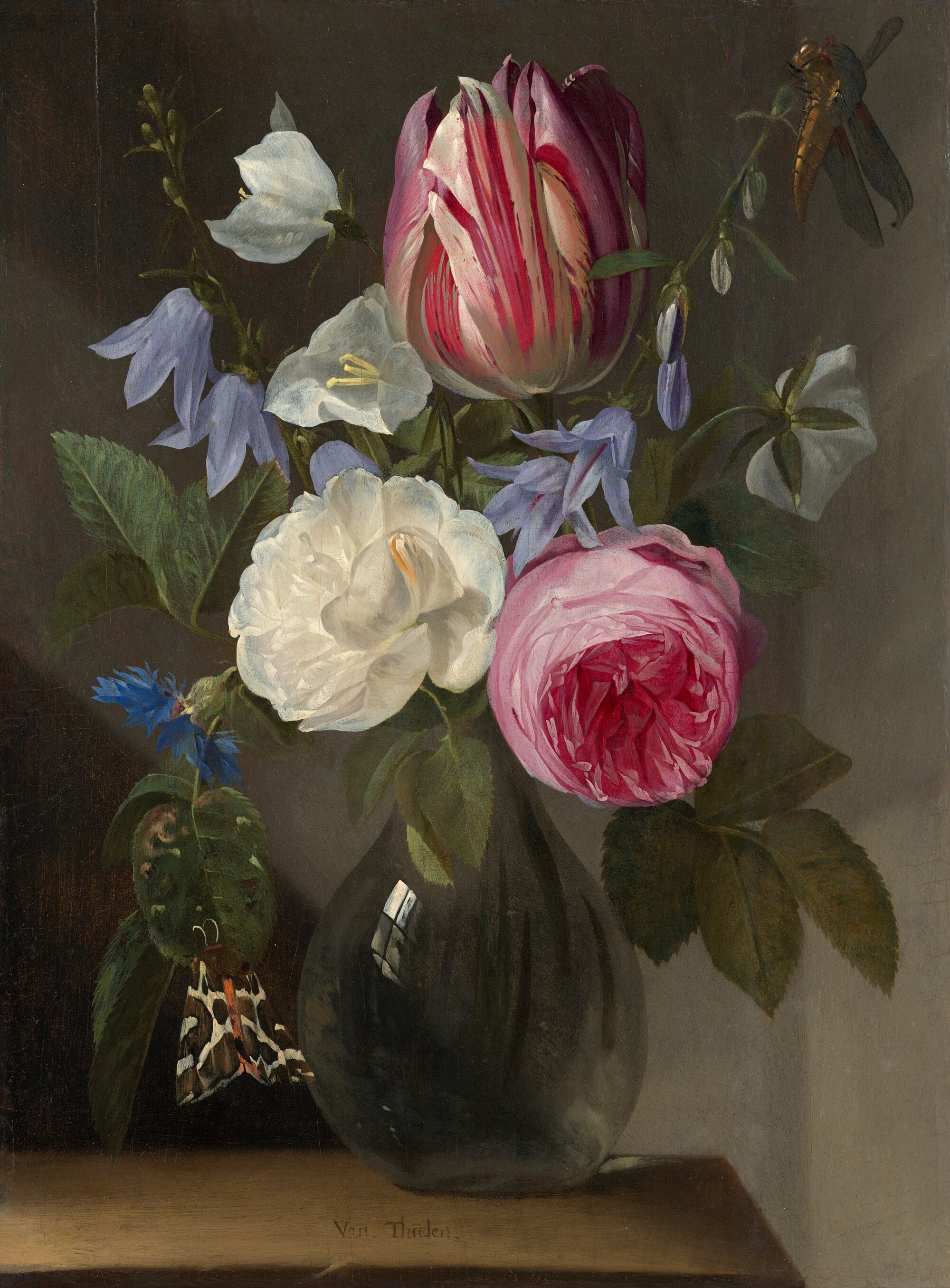
Jan Philips van Thielen » Roses and a Tulip in a Glass Vase » c. 1650/1660 » Oil on panel, 12½ × 9¼ in (32 × 23.4 cm) » Flemish Baroque
National Gallery of Art, Washington, Collection of Mrs. Paul Mellon
From the Goodie Collection · Baroque Still Life
It is barely larger than a sheet of notebook paper, but this small Flemish painting holds a whole garden in a single glass vase: a striped tulip, two full roses, bellflowers in blue and white, bright cornflowers and, if you look closely, two uninvited guests. Jan Philips van Thielen painted it in Antwerp around the 1650s, when flower paintings were among the most prized pictures a collector could own.
Bouquets like this one were rarely painted from a single arrangement. Artists worked from studies made over many months, so flowers that bloom in different seasons could share the same vase, a perfect bouquet that could never exist in real life, and would never wilt.
The striped tulip

At the top of the bouquet stands its star: a tulip streaked with crimson and white, like a flame. In the 1600s, striped tulips like this were the most coveted flowers in Europe, and in the Dutch “tulip mania” of the 1630s a single rare bulb could sell for more than a house. No one knew then what caused the dramatic stripes. Scientists discovered only in the twentieth century that they come from a virus, which also weakened the bulbs, making them even rarer.
Two roses

Below the tulip, two roses glow side by side, one white and one pink. Look at the pink one: its petals curl and overlap, pale at the edges and deepening to a rich crimson at the center. Roses were van Thielen’s specialty, and they dominate many of his paintings. You can almost smell this one.
A window in the glass

Now look at the vase. On its curved glass, a small bright shape catches the light: the reflection of a window, divided into panes. It is a favorite trick of Flemish and Dutch painters, a tiny glimpse of the room where the bouquet stood, and a reminder of the light that made every petal visible.
A perfect bouquet that could never exist in real life, and would never wilt.
Uninvited guests

Look at the lower left, on a leaf hanging by the vase, and you will find a moth, its wings patterned in chocolate brown and cream with a flash of orange. Then look up to the top right corner, where a dragonfly rests on a stem, its wings almost transparent.

Insects like these turn up in many flower paintings of the time. They show off the painter’s skill, and they make the bouquet feel alive, as if it had just been carried in from the garden. They can also carry a gentle message: beauty is fleeting, and even the loveliest flowers will fade.
A touch of blue

Finally, find the cornflowers on the left, a flash of pure, bright blue against the soft pinks and whites. Next to them, the bellflowers in lavender and white nod on their stems. And at the very bottom, painted on the edge of the ledge as if written there, is the artist’s signature: Van. Thielen.

From the Goodie Shop
Roses and a Tulip in a Glass Vase
Jan Philips van Thielen
$9 or 3+ for $8 each
- 5 × 7 in fine art print, vertical, printed full bleed
- 230gsm matte fine art paper
- Free U.S. shipping
About the Painter
Jan Philips van Thielen (1618–1667)
Jan Philips van Thielen was born in 1618 in Mechelen, in what is now Belgium, into a family with a noble title: his father was the Lord of Couwenberg. At thirteen he went to Antwerp to train with his brother-in-law, the painter Theodoor Rombouts, and later studied with Daniel Seghers, a Jesuit lay brother and one of the most celebrated flower painters of the age.
In 1641 he became a master in Antwerp’s painters’ guild. He often painted flower garlands and cartouches around religious scenes by other artists, including Erasmus Quellinus II, whose sister-in-law, Francesca de Hemelaer, he married in 1639. The couple had nine children, and van Thielen taught three of his daughters to paint flowers too.
He returned to Mechelen in 1660 and died in 1667 in the nearby village of Booischot. His flower pieces, with their glowing roses, now hang in museums including the Rijksmuseum in Amsterdam and the Fitzwilliam in Cambridge.
About the Genre
Baroque Still Life
The Baroque period, roughly the 1600s, was an age of drama in art: deep shadows, glowing highlights and a strong sense of realism. In Flanders and the Netherlands, painters brought that same intensity to small, quiet subjects like a few flowers in a vase.
Van Thielen trained with Daniel Seghers, the great Antwerp flower painter. Baroque flower pieces like this one set brilliantly lit blooms against a dark background, so each petal seems to step toward you, while insects and drooping stems remind us that the moment will pass.
The Goodie Letter Club
New Art in Your Mailbox, Every Month
Roses and a Tulip in a Glass Vase was the featured art greeting card in September’s Goodie Letter. Join the club for a new letter, fresh art and a few surprises in your mailbox each month.
Free U.S. shipping. Cancel anytime.
Image: Jan Philips van Thielen, Roses and a Tulip in a Glass Vase, c. 1650/1660. National Gallery of Art, Washington, Collection of Mrs. Paul Mellon 1992.51.4. Open access.