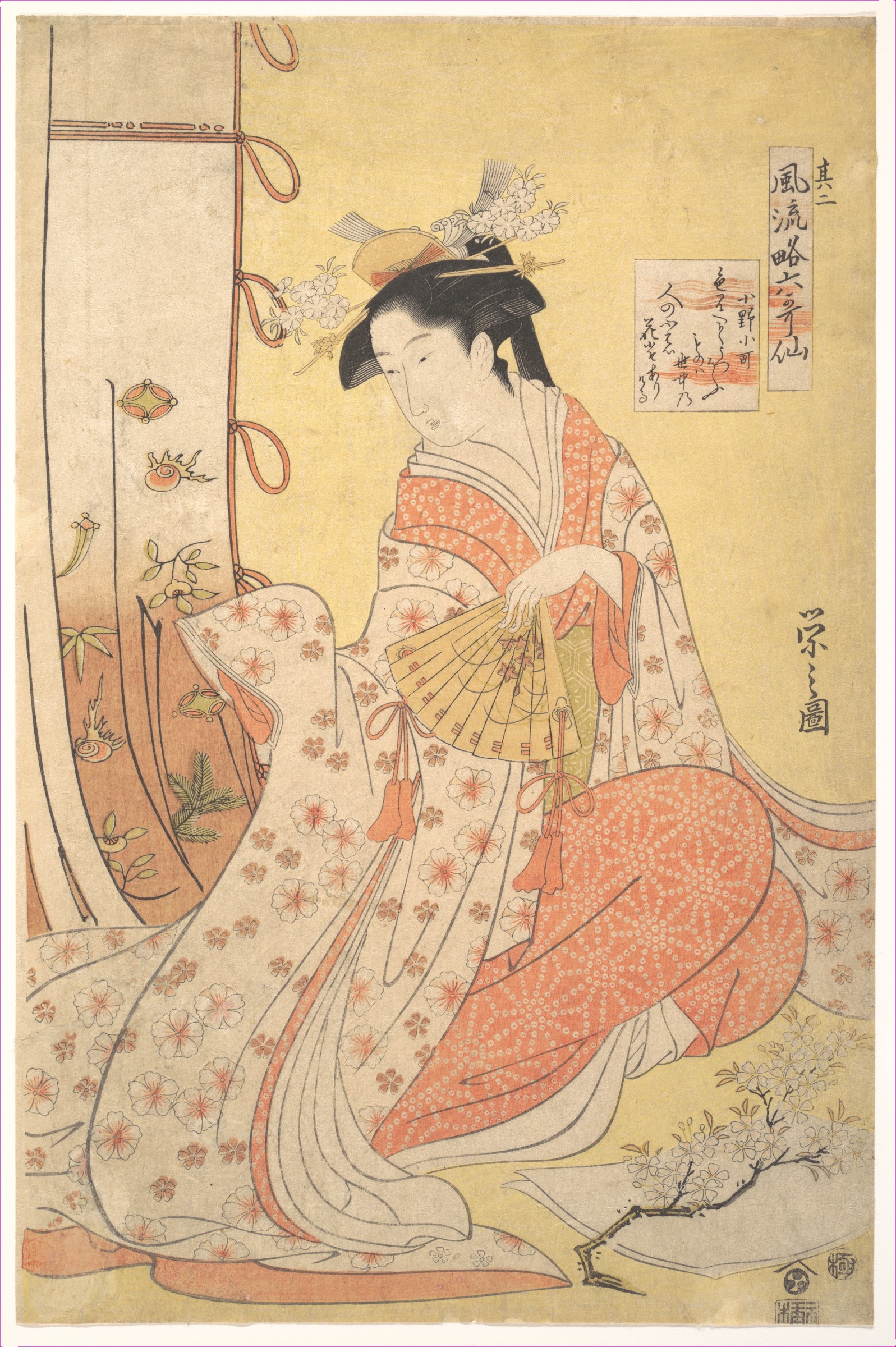
Chōbunsai Eishi » Ono no Komachi, from the series Stylish Parodies of the Six Poetic Immortals » 1790s » Woodblock print; ink and color on paper, 14⅝ × 9⅝ in (37.1 × 24.4 cm) » Japanese Prints
The Metropolitan Museum of Art, New York, Henry L. Phillips Collection, Bequest of Henry L. Phillips, 1939
From the Goodie Collection · Japanese Prints
A young woman kneels in layers of patterned silk, a folded fan in her hand, her eyes lowered toward a branch of cherry blossoms at her feet. She looks like a fashionable lady of 1790s Edo, the city we now call Tokyo. But she is meant to be someone much older: Ono no Komachi, a poet who lived more than nine hundred years before this print was made.
Komachi was the only woman among the Six Poetic Immortals, a group of ninth-century poets honored in Japan for centuries. Her beauty became legendary, and so did her poems, many of them about love and how quickly it changes. In this print, Chōbunsai Eishi imagines her as a stylish woman of his own day, a playful idea his viewers would have recognized and enjoyed.
A crown of blossoms

Her dark hair is swept up and held with long ornamental pins, then crowned with sprigs of cherry blossom. Eishi drew every strand with fine, even lines. Lines this delicate had to be carved by hand into a block of wood, the work of one of several skilled craftsmen who made each print.
The folded fan

In one hand she holds a folding fan, half open, with red cords and tassels hanging below. A fan was an everyday accessory for a woman of fashion and a favorite prop in prints of beautiful women. Here it also gives her hands something graceful to do as she gazes down.
A poem in a frame

In the upper right corner, a tall label gives the title of the series and marks this print as number two. Beside it, a small panel trimmed with red clouds holds one of Komachi’s own poems. In short, it says that the flower that fades without showing it is the human heart. The cherry blossoms throughout the print echo that thought: they are lovely, and they never last.
A ninth-century poet, dressed in the fashions of 1790s Edo.
Behind the curtain

On the left stands a cloth curtain on a wooden frame, tied with knotted red ribbons. Screens like this were used in noble households of Komachi’s era to give women privacy. Its little painted decorations hint at the old court world she came from, even as she wears the latest styles.
Fallen blossoms

At her feet lies a cut branch of cherry blossoms. In Japan, cherry blossoms are cherished precisely because they fall so soon after they open. Placing a fallen branch beside a poet famous for her beauty is Eishi’s quiet way of reminding us that beauty, too, is brief.
The artist’s signature

Along the right edge, the brushed characters read Eishi zu, meaning “drawn by Eishi.” In the lower corner you can spot small seals, the kind of marks publishers and official censors stamped on prints of this period.

From the Goodie Shop
Ono no Komachi
Chōbunsai Eishi
$9 or 3+ for $8 each
- 5 × 7 in fine art print, vertical, printed full bleed
- 230gsm matte fine art paper
- Free U.S. shipping
About the Artist
Chōbunsai Eishi (1756–1829)
Chōbunsai Eishi was born in 1756 into a samurai family in the service of the shogun, Japan’s military ruler. He trained in the Kanō school, the official painting style of the shogun’s court, and for a time painted in the circle of the shogun Tokugawa Ieharu, who is said to have given him the art name Eishi.
In the mid-1780s he left his official post and turned to ukiyo-e, the popular prints of Edo’s lively entertainment world. He became known for tall, slender, elegant women drawn with a calm refinement that reflected his upper-class training. Around 1798 he stopped designing prints and devoted the rest of his life to painting. He died in 1829.
About the Genre
Japanese Prints
Ukiyo-e means “pictures of the floating world,” the pleasure-loving city life of Edo-period Japan (1615–1868). These woodblock prints showed actors, beautiful women, landscapes and scenes from legend, and they were affordable enough for ordinary people to buy and collect.
Each print was a team effort. An artist drew the design, a carver cut it into blocks of cherry wood, and a printer brushed on ink and color one block at a time, pressing the paper by hand. Artists loved to play with the past, dressing famous poets and heroes in the fashions of their own day, just as Eishi does with Komachi here.
The Goodie Letter Club
New Art in Your Mailbox, Every Month
Ono no Komachi was part of June’s Goodie Letter. Join the club for a new letter, fresh art and a few surprises in your mailbox each month.
Free U.S. shipping. Cancel anytime.
Image: Chōbunsai Eishi, Ono no Komachi: Number Two, from the series Stylish Parodies of the Six Poetic Immortals, 1790s. The Metropolitan Museum of Art, New York, Henry L. Phillips Collection, Bequest of Henry L. Phillips, 1939 (JP2815). Open access.