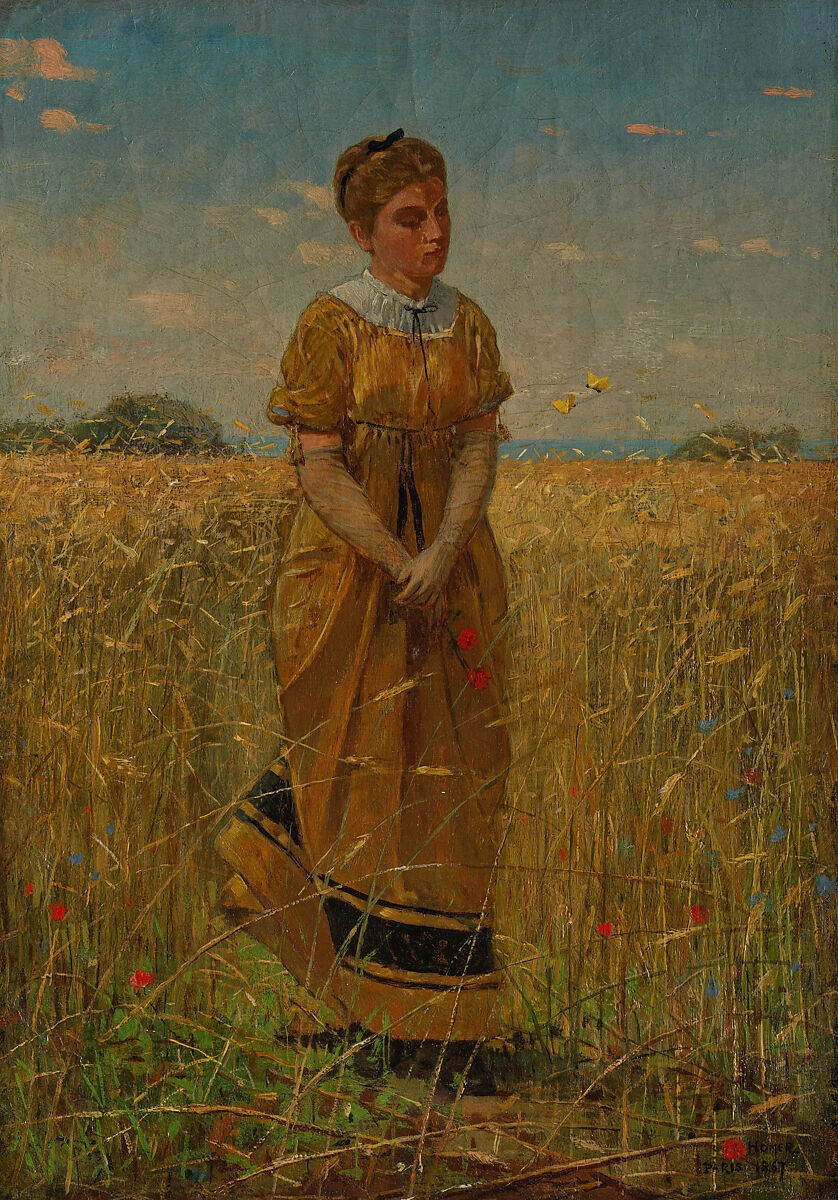
Winslow Homer » Coming through the Rye » 1867 » Oil on canvas, 16¾ × 11⅝ in (42.5 × 29.5 cm) » American Realism
The Metropolitan Museum of Art, New York, Gift of the Van Doren family, in honor of Elizabeth Mankin Kornhauser, 2025
From the Goodie Collection · American Realism
A young woman walks through a field of rye that grows almost to her waist. Her dress is the same golden color as the grain, so she seems to grow out of the field itself. She looks down, lost in thought, holding a few red blossoms. Winslow Homer painted her in 1867, during the ten months he spent in France.
The title comes from “Comin’ Thro’ the Rye,” a poem by the Scottish poet Robert Burns that became a popular song. Burns’s version is a cheeky tale of a young woman meeting a sweetheart in a rye field, and Homer’s viewers would have known the tune. His painting keeps only the hint of a story and leaves the rest to us. The Met acquired it in 2025. Let’s take a closer look.
Lost in thought

Her eyes are lowered and her face is calm. Her hair is pulled back with a black ribbon, and a ruffled white collar is tied at her throat with a tiny black bow. She does not look at us. Whatever she is thinking about, Homer lets her keep it to herself.
A dress from another time

Look closely at her clothes. The high waist, short puffed sleeves and long gloves look more like the fashions of around 1800, the age of Robert Burns, than the full skirts women wore in 1867. Her golden skirt, trimmed with bands of black, seems to swirl behind her as she walks, as if a breeze has just passed through the field.
Gloves and red blossoms

Her hands are folded in front of her, covered in long pale gloves. Just below them are a few red blossoms, the brightest spots in the whole painting. They draw your eye straight to the center of the picture, and to the hands that hold them.
A painting named for a love song, with the story left out on purpose.
Butterflies in the breeze

Beside her shoulder, two small yellow butterflies flutter above the rye. They are only a few dabs of paint, but they bring the summer air to life.
Poppies and cornflowers

Search the field and you’ll find red poppies and blue cornflowers growing among the stalks. These wildflowers grew in grain fields all over Europe, and French painters of the day loved them. Homer scattered them through the rye like confetti.
The far horizon

Behind her, the field stretches to a line of dark trees and a thin band of blue at the horizon. Homer kept the background simple so that nothing competes with the figure.
Signed in Paris

In the lower right corner, beside one last red flower, Homer signed his name and wrote where and when he painted it: “HOMER / PARIS 1867.” That year, two of his paintings hung in the American section of the Paris World’s Fair.
About the Painter
Winslow Homer (1836–1910)
Winslow Homer was born in Boston in 1836. He began his career as an apprentice to a lithographer and then as a freelance illustrator for magazines like Harper’s Weekly, which sent him to draw soldiers’ daily life during the Civil War.
After the war, Homer sailed for France in late 1866 and stayed about ten months, based in Paris. Two of his Civil War paintings were shown at the 1867 World’s Fair, and he spent time in the French countryside painting farm women, gleaners and harvest fields in the spirit of the Barbizon painters, who were popular with American collectors. Coming through the Rye belongs to this group of French pictures, which he later exhibited in New York.
Later, after a stay in the English fishing village of Cullercoats, he settled at Prouts Neck, on the coast of Maine, where he painted the powerful seascapes and watercolors that made him one of America’s greatest artists. He died there in 1910.
About the Genre
American Realism
American Realists painted ordinary people and real places instead of myths, kings and heroic battles. Many of them trained or traveled in France, where painters like Jean-François Millet had already turned farm workers into serious subjects for art.
In France, Homer saw how the Barbizon painters gave dignity to people working the land. He brought that lesson home with him, and it shaped the farm scenes, schoolyards and fields he painted in America for the next decade.
The Goodie Letter Club
New Art in Your Mailbox, Every Month
Coming through the Rye was part of November’s Goodie Letter, A Seat at the Table. Join the club for a new letter, fresh art and a few surprises in your mailbox each month.
Free U.S. shipping. Cancel anytime.