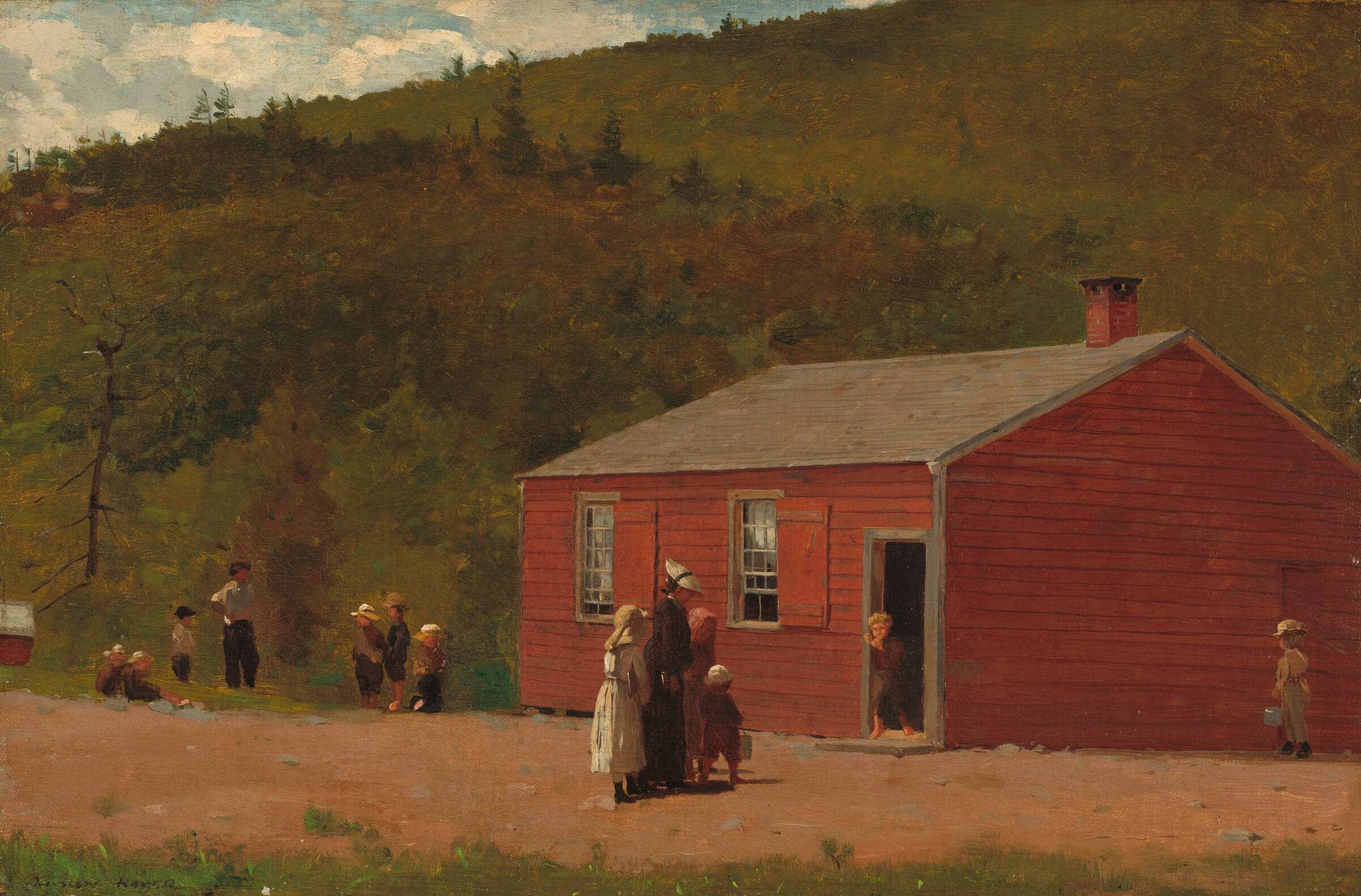
Winslow Homer » School Time » c. 1874 » Oil on canvas, 12½ × 19¼ in (31.75 × 48.9 cm) » American Realism
National Gallery of Art, Washington, Collection of Mr. and Mrs. Paul Mellon
From the Goodie Collection · American Realism
A little red schoolhouse sits at the foot of a green hill. It is morning, and the children are arriving: some still dawdling on the grass, some clustered around their teacher, one already peeking out the door. Winslow Homer painted this small scene around 1874, and it captures something Americans were already starting to feel nostalgic about, the one-room country school.
The schoolhouse was likely the one in Hurley, a village in New York’s Hudson Valley, where Homer spent time in the early 1870s. The same red building, with the same steep hill behind it, appears in one version of his famous painting of children at recess, Snap the Whip. Let’s take a closer look.
The teacher

At the center stands the teacher, in a long black dress and a white hat, bending slightly toward the children around her. A girl in a pale dress and bonnet stands beside her, and a smaller boy holds a lunch pail. In the 1870s, many country teachers were young women, sometimes barely older than their oldest students, who taught every grade in a single room.
A face at the door

Look at the open doorway. A small, barefoot, tousle-haired boy peeks out, one hand at his face, as if he’s already inside and waiting for everyone else, or maybe trying to get a head start on mischief. Homer had a wonderful eye for children caught in the middle of a moment.
Not quite ready for class

Over on the left, a group of children in straw hats is clearly in no hurry. A couple sit on the grass, others stand and chat, and a taller boy in a white shirt looks on with his hands on his hips. Anyone who has ever been a child on a sunny morning knows exactly how they feel.
A small painting of a big American memory: the one-room country school.
The schoolhouse itself

The schoolhouse is simple and sturdy: red clapboard walls, wooden shutters and small-paned windows with white curtains. Notice how the morning sun warms the red siding and makes the white curtains glow.

A single brick chimney rises from the gray roof, a reminder of the wood stove inside that would have heated the whole room on cold mornings, and that one of the older students was often in charge of keeping lit.
Last to arrive

And at the far right, a boy stands alone by the corner of the building, holding a shiny lunch pail. He seems to be taking his time, perhaps the last one to arrive. Homer signed the painting in the lower left corner, in the grass: “WINSLOW HOMER.”

From the Goodie Shop
School Time
Winslow Homer
$9 or 3+ for $8 each
- 5 × 7 in fine art print, horizontal, printed full bleed
- 230gsm matte fine art paper
- Free U.S. shipping
About the Painter
Winslow Homer (1836–1910)
Winslow Homer was born in Boston in 1836. He began his career as an apprentice to a lithographer and then as a freelance illustrator for magazines like Harper’s Weekly, which sent him to draw soldiers’ daily life during the Civil War.
After the war, he turned to scenes of everyday American life. In the early 1870s he painted a series of pictures of country children: boys playing Snap the Whip outside a red schoolhouse, children in the fields, a young teacher in her classroom. These gentle, sunlit scenes, including School Time, were popular with Americans eager to remember a simpler, rural way of life after the upheaval of the war.
Later, after a stay in the English fishing village of Cullercoats, he settled at Prouts Neck, on the coast of Maine, where he painted the powerful seascapes and watercolors that made him one of America’s greatest artists. He died there in 1910.
About the Genre
American Realism
American Realists painted the country as it was changing after the Civil War. Rather than heroic battles or idealized landscapes, they recorded small scenes of daily life that many people would recognize from their own childhood.
Homer painted a series of one-room schoolhouses in the early 1870s. Children, a teacher and a simple red building in a hillside landscape: nothing dramatic happens, yet these quiet images became some of the most beloved pictures of rural American life.
The Goodie Letter Club
New Art in Your Mailbox, Every Month
School Time was the art notecard in November’s Goodie Letter, A Seat at the Table. Join the club for a new letter, fresh art and a few surprises in your mailbox each month.
Free U.S. shipping. Cancel anytime.
Image: Winslow Homer, School Time, c. 1874. National Gallery of Art, Washington, Collection of Mr. and Mrs. Paul Mellon 2014.18.19. Open access.