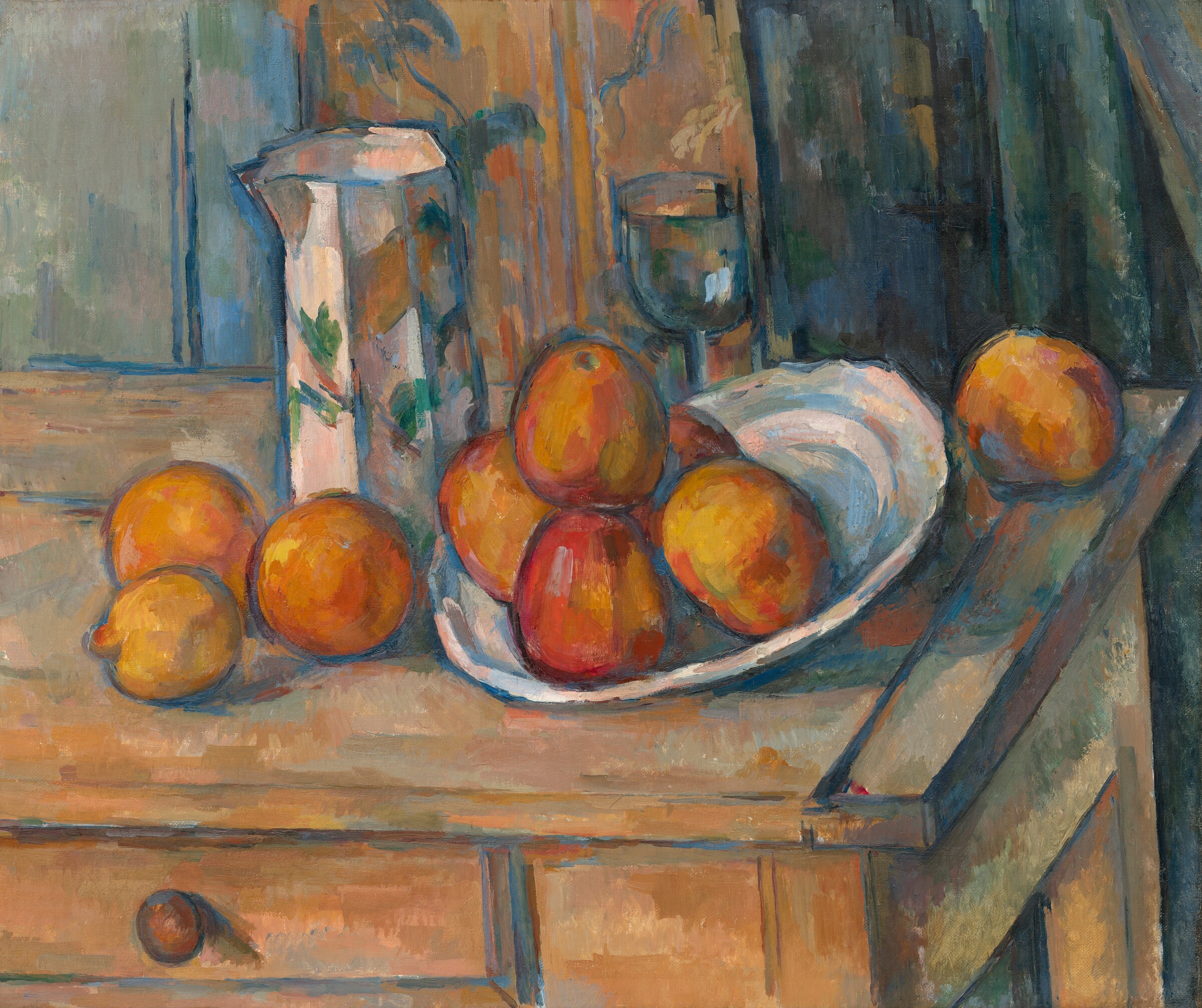
Paul Cézanne » Still Life with Milk Jug and Fruit » c. 1900 » Oil on canvas » Post-Impressionism
National Gallery of Art, Washington, Gift of the W. Averell Harriman Foundation in memory of Marie N. Harriman
From the Goodie Collection · Post-Impressionism
A milk jug, a glass, a white dish and a handful of apples and oranges on a wooden chest of drawers. It is about as ordinary as a subject can be, and yet Paul Cézanne painted tables like this one again and again, for decades, until they changed the course of modern art. “I want to astonish Paris with an apple,” he is reported to have said. Look closely, and you will see how he did it.
At first glance the painting looks loose, almost unfinished. But every patch of color is placed deliberately, and the closer you look, the more you notice that things here don’t quite behave the way they do in real life.
Fruit built from color

Look at the fruit on the dish. Cézanne doesn’t blend his colors smoothly. Instead he builds each apple and orange from small, separate patches of red, orange, yellow and even green, laid side by side like tiles. Up close they look like abstract strokes; step back and they become round, solid and heavy, sitting firmly in the dish.
Blue outlines

Now look at the edges of the fruit on the left. Around each orange and the little lemon runs a line of blue. Cézanne outlined almost everything in this painting, from the fruit to the jug to the table, with strokes of cobalt blue, which helps each object hold its shape against the warm wood.
The milk jug

Behind the fruit stands a tall white milk jug painted with green leaves. Its white isn’t really white at all; look again and you’ll see pinks, blues and grays, picked up from everything around it. Cézanne was fascinated by how color shifts with light and with the colors nearby.
“I want to astonish Paris with an apple.”
Attributed to Paul Cézanne
A glass of a few strokes

The goblet beside the jug is barely there: a few strokes of gray, blue and white, with the warm background showing straight through. And yet you read it instantly as glass. It is a lovely example of how little paint Cézanne needed when he chose his marks carefully.
A table that tilts

Here is the strangest thing about the painting. Look at the table. The left side seems to be seen from straight ahead, but the right side tilts up toward us, as if we were looking down on it from above. The edges don’t quite line up. Cézanne painted his still lifes from several points of view at once, combining what he saw as he moved his head. Later painters, including Picasso and Braque, took that idea and ran with it, and it led to Cubism.
The drawer knob

Finally, look all the way down at the bottom left: a single round drawer knob, painted with the same care as the fruit above it. To Cézanne, it was just another shape to study, a small sphere sitting on a flat plane, as worthy of attention as any apple.

From the Goodie Shop
Still Life with Milk Jug and Fruit
Paul Cézanne
$9 or 3+ for $8 each
- 5 × 7 in fine art print, horizontal, printed full bleed
- 230gsm matte fine art paper
- Free U.S. shipping
About the Painter
Paul Cézanne (1839–1906)
Paul Cézanne was born in 1839 in Aix-en-Provence, in the south of France, the son of a prosperous banker who hoped he would become a lawyer. His closest childhood friend was the future novelist Émile Zola, who encouraged him to follow him to Paris and become a painter.
In Paris, Cézanne was rejected again and again by the official Salon. He showed his work alongside Monet, Renoir and Pissarro in the first Impressionist exhibition in 1874, but he soon went his own way, trying, as he put it, to make Impressionism into “something solid and durable, like the art of the museums.” He worked mostly back home in Provence, painting the same mountain, Mont Sainte-Victoire, the same card players and the same tabletops of fruit, over and over.
Recognition came late. His first solo exhibition, organized by the dealer Ambroise Vollard, opened in Paris in 1895, when he was in his mid-fifties. He died in Aix in 1906, after being caught in a storm while painting outdoors. Within a few years, younger artists like Matisse and Picasso were calling him the father of modern art.
About the Genre
Post-Impressionism
Post-Impressionism grew out of Impressionism in the 1880s. These artists kept its fresh color but wanted their paintings to feel more solid, structured and lasting.
Cézanne is often quoted as wanting to make Impressionism into something solid and enduring, like the art of the museums. In his still lifes he tilts tables, shifts viewpoints and builds each piece of fruit out of small patches of color, a new way of seeing that inspired Picasso and the Cubists.
The Goodie Letter Club
New Art in Your Mailbox, Every Month
Still Life with Milk Jug and Fruit was the art greeting card in October’s Goodie Letter. Join the club for a new letter, fresh art and a few surprises in your mailbox each month.
Free U.S. shipping. Cancel anytime.
Image: Paul Cézanne, Still Life with Milk Jug and Fruit, c. 1900. National Gallery of Art, Washington, Gift of the W. Averell Harriman Foundation in memory of Marie N. Harriman 1972.9.5. Open access.