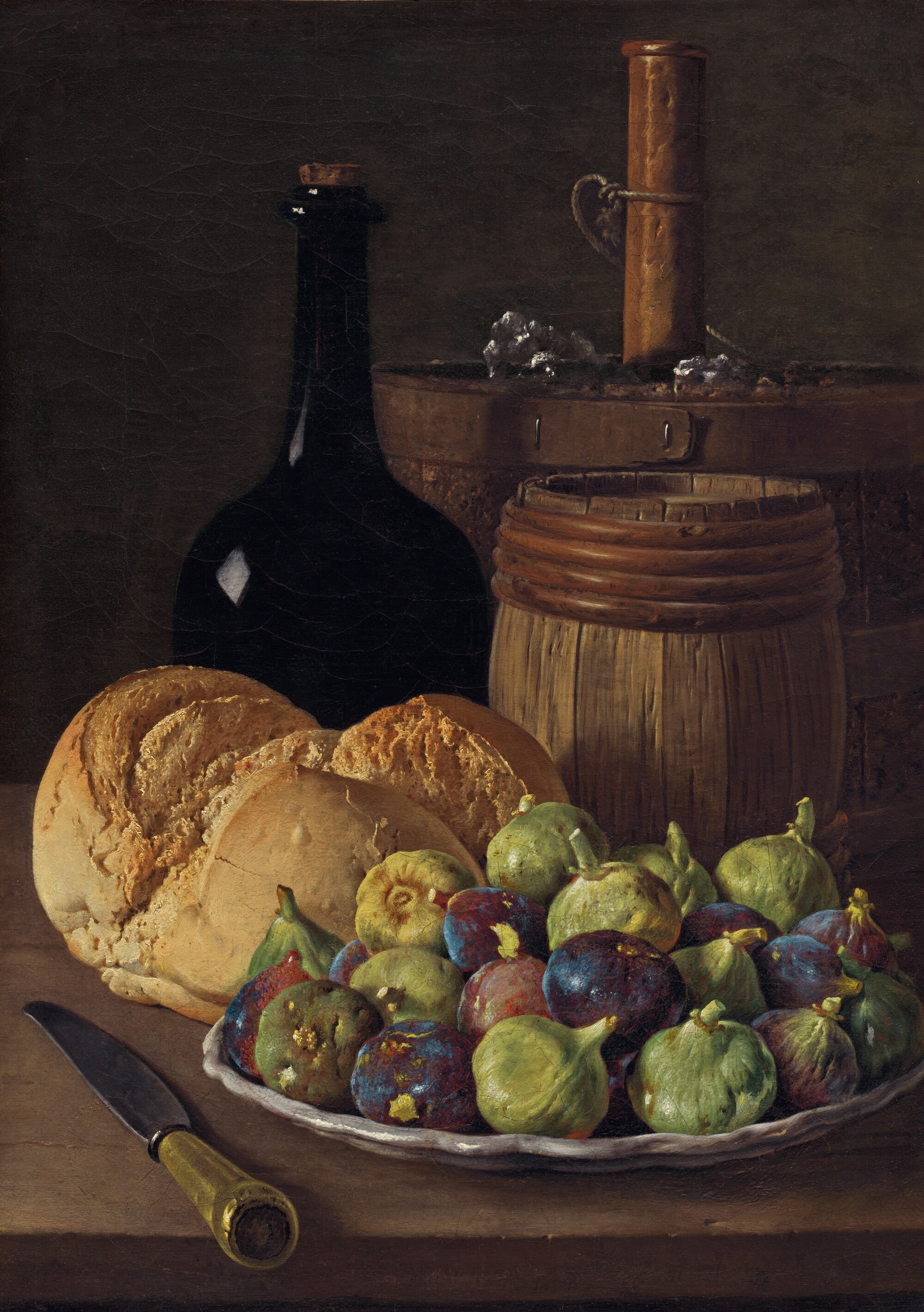
Luis Meléndez » Still Life with Figs and Bread » c. 1770 » Oil on canvas, 18¾ × 13½ in (47.6 × 34 cm) » Spanish Still Life
National Gallery of Art, Washington, Patrons’ Permanent Fund
From the Goodie Collection · Spanish Still Life
A loaf of bread, a dish of figs, a bottle of wine and a flask chilling on ice: it could be an afternoon snack set out on a kitchen table in Madrid around 1770. Luis Meléndez, the great Spanish still-life painter of the eighteenth century, turned simple, everyday food into something almost monumental. Nothing here is fancy, and yet every object has weight, texture and presence, as if you could reach into the picture and take a fig.
Meléndez painted from life, setting real objects on a plain wooden ledge, lighting them from one side and studying them with enormous patience. The result is a kind of portrait of things. Let’s look closer.
A dish of figs

Front and center sits a shallow, scalloped dish heaped with about two dozen figs, some deep purple with blushes of blue and red, others pale green with yellowish tips. No two are alike. Each one is turned at a slightly different angle, and each catches the light in its own way.

Now look at a single fig up close. Some are perfectly smooth, but others are bruised, split or cracked open, showing tiny flecks of golden flesh. Meléndez didn’t pick the prettiest fruit; he painted it as it really was, perfectly ripe and just beginning to turn. That honesty is a big part of why his paintings feel so alive.
Bread you can almost smell

Behind the figs is a round loaf of bread with a deep split across the top. Look at the difference between the crackly, golden crust and the paler, softer bread where the loaf has risen and torn. You can almost hear it crunch.
Nothing here is fancy, and yet every object has weight, texture and presence.
A window in the bottle

A tall, dark glass bottle stands behind the bread, sealed with a cork. On its glossy curve, a small bright shape catches the light: the reflection of a window. It is the same trick you’ll find in Dutch and Flemish still lifes, a tiny glimpse of the room beyond the picture, and a sign of exactly where the light is coming from.
Wine on ice

At the back, a tall copper flask sits in a wooden bucket, surrounded by pale chunks of ice. This was an eighteenth-century wine cooler. In Madrid, snow and ice were gathered in the mountains, stored in deep pits and sold in the city to chill drinks in the heat of summer. It’s a lovely, practical detail: someone is planning a cold drink to go with their bread and figs.
The knife

Finally, look at the knife in the lower left corner. Its handle sticks out over the edge of the table, pointing right at us, while the blade angles back into the picture. It is an old painter’s trick for pulling the viewer in, as if the knife were waiting for you to pick it up and cut the first slice of bread.

From the Goodie Shop
Still Life with Figs and Bread
Luis Meléndez
$9 or 3+ for $8 each
- 5 × 7 in fine art print, vertical, printed full bleed
- 230gsm matte fine art paper
- Free U.S. shipping
About the Painter
Luis Meléndez (1715–1780)
Luis Meléndez was born in Naples in 1715, the son of a Spanish painter, Francisco Antonio Meléndez, who made miniature portraits for the royal court. The family moved to Madrid, and Luis trained in his father’s studio and became one of the first students at Spain’s new Royal Academy of Fine Arts.
His promising start was cut short when his father quarreled with the Academy and both father and son were expelled. Luis spent time in Italy and later earned his living partly by decorating choir books. In the 1770s, the Prince of Asturias, the future King Charles IV, commissioned him to paint a series of still lifes showing the foods of Spain, a project that produced many of his finest works, now largely in the Prado Museum.
Despite his talent, Meléndez never won the court position he hoped for, and he died in Madrid in 1780 in poverty. Today he is celebrated as the greatest Spanish still-life painter of the eighteenth century. His self-portrait, holding a drawing of a nude study, hangs in the Louvre.
About the Genre
The Spanish Still Life
Spain has a long tradition of still-life painting called the bodegón, a word linked to a humble tavern or pantry. Instead of luxurious flowers, Spanish painters often chose everyday food and kitchen things, painted with great seriousness and care.
Meléndez is considered the greatest Spanish still-life painter of the 1700s. He set simple objects like bread, fruit, jugs and boxes close to the viewer on a plain ledge, under strong light, so you can almost feel the crust of the bread and the soft skin of the figs.
The Goodie Letter Club
New Art in Your Mailbox, Every Month
Still Life with Figs and Bread was the postcard in September’s Goodie Letter. Join the club for a new letter, fresh art and a few surprises in your mailbox each month.
Free U.S. shipping. Cancel anytime.
Image: Luis Meléndez, Still Life with Figs and Bread, c. 1770. National Gallery of Art, Washington, Patrons’ Permanent Fund 2000.6.1. Open access.