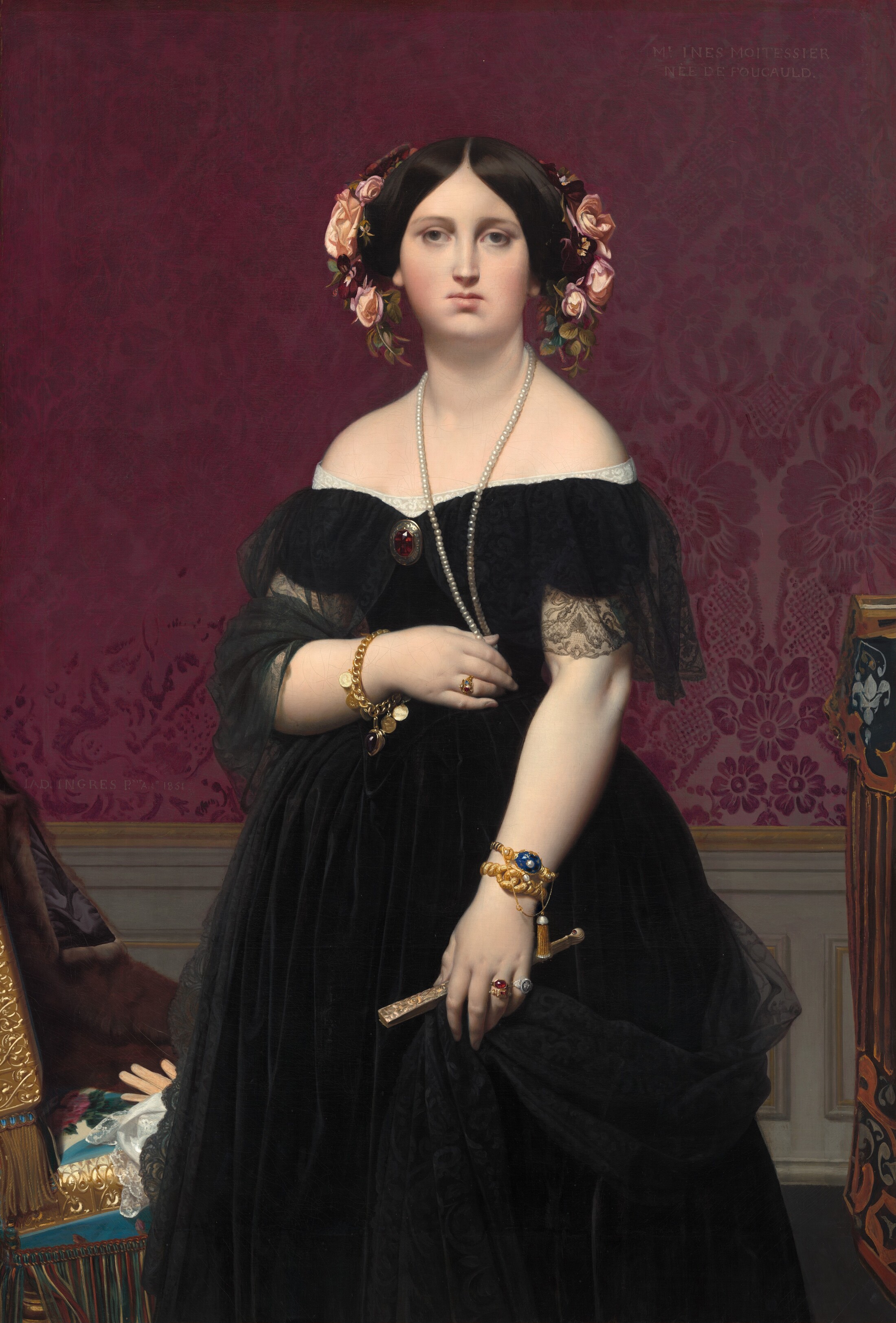
Jean-Auguste-Dominique Ingres » Madame Moitessier » 1851 » Oil on canvas, 57¾ × 39¼ in (147 × 100 cm) » French Neoclassicism
National Gallery of Art, Washington, Samuel H. Kress Collection
From the Goodie Collection · Neoclassicism
She stands against a wall of deep raspberry silk, dressed in black velvet and lace, and looks straight at us without a hint of a smile. Roses crown her dark hair, pearls fall to her waist and gold glitters on both wrists. This is Inès Moitessier, painted in 1851 by Jean-Auguste-Dominique Ingres, one of the greatest portrait painters who ever lived, and a man who, at first, refused to paint her at all.
In 1844 a friend asked Ingres to take the commission. He said no: he thought portraits were beneath a serious painter of history and myth. Then he met her, was struck by her beauty and changed his mind. What followed was one of the longest portrait sittings in art history, and two paintings instead of one.
Her name on the wall

Look at the top right corner, where faint letters seem carved into the silk: Mme Inès Moitessier, née de Foucauld. Ingres signed the painting on the opposite side, with the date, 1851. Inès was born in 1821, the daughter of a French civil servant, and at twenty-one she married Sigisbert Moitessier, a wealthy banker and lace merchant about twice her age.
A crown of roses

Her dark hair is parted precisely down the middle and smoothed flat, the height of 1850s fashion, and framed by a garland of peach roses, deep burgundy blooms and sage-green leaves that falls to her chin on both sides. Her face is calm, pale and almost perfectly symmetrical. Ingres often adjusted his sitters toward an ideal of smooth, classical beauty, and here she looks less like a snapshot of a person than like a statue come to life.
Pearls and a red jewel

At the center of her neckline sits a large oval red jewel in a silvery-gold setting, and a long rope of pearls loops down to her waist. Follow the pearls and you’ll find her right hand holding the end of the strand, as if she were idly turning it in her fingers.
Every bracelet, ring and charm is painted as carefully as her face.
Gold on her wrists

Now look at her hands, because Ingres clearly loved them. On her right wrist hangs a heavy gold chain bracelet dangling with little coin-like disks and charms, and on her finger, a gold ring set with a pearl and tiny red and blue stones.

Her left arm is stacked with bracelets: one of gold and pearls, another with a sky-blue enamel medallion around a pearl. She wears two gold rings with red stones and a silver crest ring on her little finger, and she holds a closed fan with silver and gold sticks. Every bracelet, ring and charm is painted as carefully as her face, a record of exactly what a wealthy Parisian woman wore in 1851.
Black lace

Her gown is black velvet, edged at the sleeves with wide bands of black lace that let her pale arms show through, and a sheer black shawl drapes over her shoulders. It is a fitting detail for the wife of a lace merchant, and it shows off one of Ingres’s great skills: painting fabric so precisely you can almost feel its weight.
Two portraits, one sitter
Ingres began a seated portrait of Madame Moitessier in 1844, but the work dragged on for years. Her daughter was painted in and then painted out, and in 1849 the death of Ingres’s wife stopped him for months. In June 1851, a reminder from Madame Moitessier prompted him to start fresh, and he painted this standing portrait instead, finishing it by December. Then he went back to the seated version and completed it in 1856. Today the two portraits hang an ocean apart: this one in Washington, the seated one at the National Gallery in London. In 2022 they were shown side by side for the first time.
About the Painter
Jean-Auguste-Dominique Ingres (1780–1867)
Ingres was born in 1780 in Montauban, in the south of France. His father was a painter and musician who taught him both arts, and Ingres played the violin all his life. His hobby became so famous that the French still call a person’s second passion their violon d’Ingres.
He studied in Paris with Jacques-Louis David, the leading painter of the day, and in 1801 won the Prix de Rome. He went on to spend much of his career in Italy, absorbing Raphael and the art of the ancient world, and later served as director of the French Academy in Rome.
Ingres wanted to be known for grand paintings of history and myth, and he often complained about portraits. But his portraits, with their perfect drawing, gleaming fabrics and calm, idealized faces, are now among his most admired works. He died in Paris in 1867, at eighty-six.
About the Genre
Neoclassicism
Neoclassicism arose in the late 1700s as a reaction against the frothy Rococo. Inspired by ancient Greece and Rome, artists prized clear outlines, calm balance and a smooth, polished finish that hid every brushstroke.
Ingres was its great champion in the 1800s, insisting that drawing was the foundation of art. In Madame Moitessier the line of her shoulders, the pattern of her dress and her serene pose show the precision and idealized beauty at the heart of the style.

From the Goodie Letter
Art That Arrives in Your Mailbox
Madame Moitessier was the featured painting in September’s Goodie Letter. Each month brings a new one, tucked in with a letter, a fine-art print and a few surprises.
Free U.S. shipping. Cancel anytime.
Image: Jean-Auguste-Dominique Ingres, Madame Moitessier, 1851. National Gallery of Art, Washington, Samuel H. Kress Collection 1946.7.18. Open access.