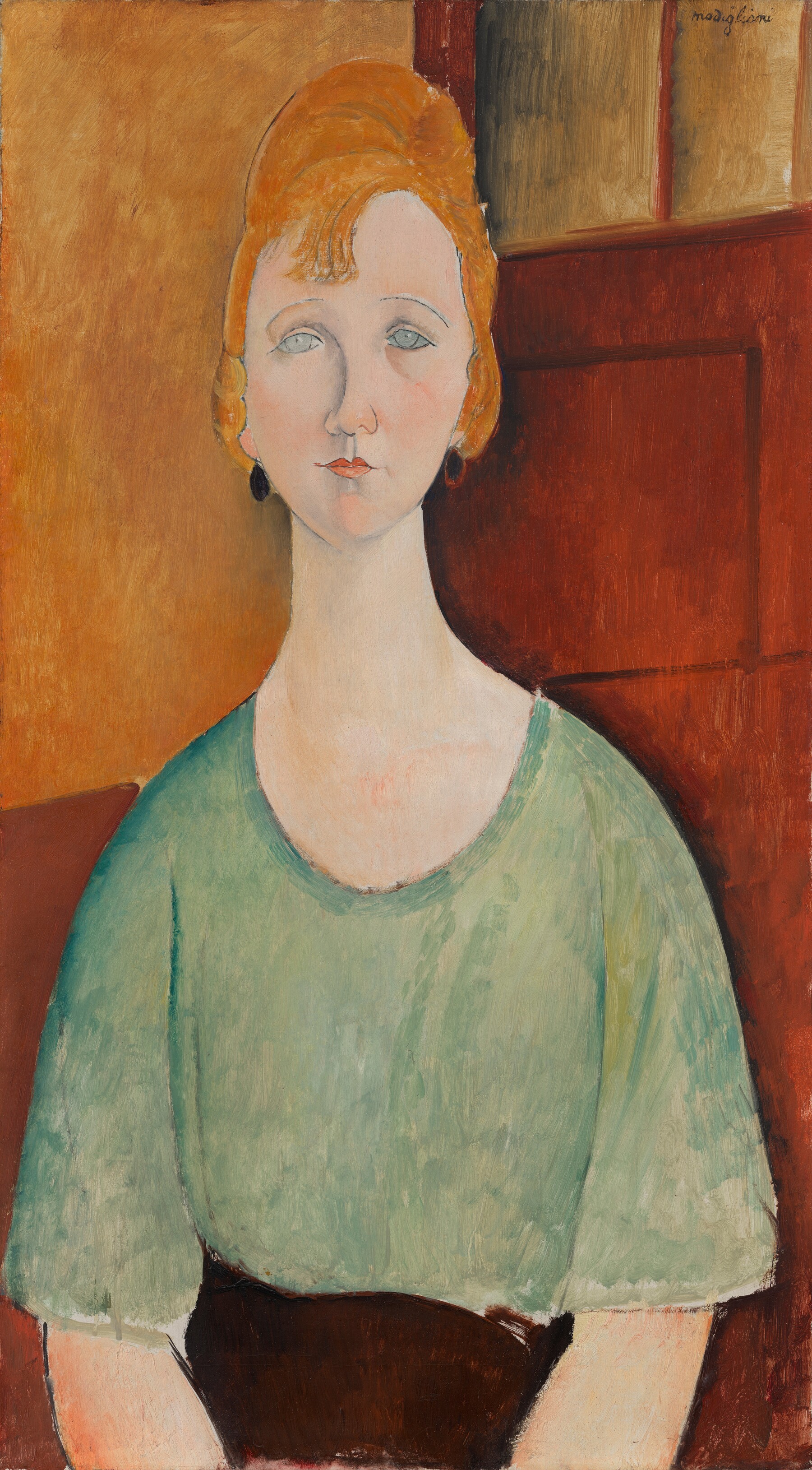
Amedeo Modigliani » Girl in a Green Blouse » 1917 » Oil on canvas, 32 × 18 in (81.3 × 46 cm) » School of Paris
National Gallery of Art, Washington, Chester Dale Collection
From the Goodie Collection · Modern Art
You would recognize a Modigliani from across a room: the long neck, the oval face, the almond-shaped eyes, the calm, slightly faraway expression. This young woman in a mint-green blouse, painted in Paris in 1917, has all of them. We don’t know who she was; the painting was first sold simply as Le Corsage Vert, “The Green Blouse.” But she has been gazing out at visitors with the same quiet patience for more than a century.
1917 was one of Modigliani’s most productive years. He was painting portraits of friends, neighbors and models in Montparnasse, simplifying each face into his own unmistakable style. Let’s look closer at how he did it.
A face like a mask

Her face is a long, smooth oval, framed by golden-orange hair swept up high on her head. The nose is long and straight, the mouth small and red, the eyebrows two thin, high arches. Modigliani began as a sculptor, and he loved ancient and African carved masks, with their simplified, elongated features. You can feel that influence here: she looks almost carved rather than painted.
Pale, empty eyes

Look closely at her eyes. They are a pale, milky blue, with irises so light they are almost white. Modigliani often painted eyes this way, sometimes leaving them completely blank. It makes his sitters seem calm and inward-looking, as if they are thinking about something far away. A well-known story has him telling a sitter, “When I know your soul, I will paint your eyes,” though, like many good stories, it may be more legend than fact.
A long, long neck

Then there is the neck, impossibly long and graceful, rising like a column from the scooped neckline of her blouse. No real neck is this long, and that’s the point. Modigliani stretched his figures to make them more elegant, the same way Renaissance painters he admired in Italy sometimes did.
“When I know your soul, I will paint your eyes.”
Attributed to Amedeo Modigliani
A dark earring

A small black oval earring hangs from each ear. Against all that soft pink, orange and green, these two dark drops are the strongest accents in the painting, and they help frame her face like a pair of punctuation marks.
The green blouse

Her mint-green blouse, with its scooped neck and elbow-length sleeves, is painted in loose, mottled strokes, with patches of lighter and darker green that let the brushwork show. That cool green sets off the warm honey-orange wall behind her and the deep red door at the right, a simple trio of colors that makes the whole painting glow.
His signature

Finally, look up to the top right corner, where the artist signed his name in thin, dark script: modigliani, all in lowercase.

From the Goodie Shop
Girl in a Green Blouse
Amedeo Modigliani
$9 or 3+ for $8 each
- 5 × 7 in fine art print, vertical, printed full bleed
- 230gsm matte fine art paper
- Free U.S. shipping
About the Painter
Amedeo Modigliani (1884–1920)
Amedeo Modigliani was born in 1884 in Livorno, on the coast of Tuscany, into a Jewish family. He studied art in Italy, falling in love with the paintings and sculpture of the Renaissance, and in 1906 he moved to Paris, where he lived and worked among artists like Picasso and the sculptor Constantin Brâncuși.
For several years he devoted himself to sculpture, carving long, elegant stone heads inspired by ancient and African art. Poor health and the dust of stone carving eventually led him back to painting, but the sculptor’s eye stayed with him in every portrait he made.
In 1917, the year he painted this portrait, his dealer organized his only solo exhibition during his lifetime; the police famously closed it on the first day because of the nudes in the window. Modigliani struggled with poverty and long illness and died in Paris in 1920, at just thirty-five. Within a few years, his paintings were among the most sought-after of his generation.
About the Genre
Modern Art in Paris
In the early 1900s, Paris was the center of the art world, and artists from all over Europe came to experiment. They broke the old rules: color did not have to be natural, shapes could be simplified and a portrait did not have to look like a photograph.
Modigliani, who came from Italy, was part of this circle in Montparnasse. Inspired by African and ancient sculpture, he gave his sitters long necks, oval faces and almond eyes, a style so personal that his portraits are recognizable at a glance.
The Goodie Letter Club
New Art in Your Mailbox, Every Month
Girl in a Green Blouse was the 5×7 fine art print in October’s Goodie Letter. Join the club for a new letter, fresh art and a few surprises in your mailbox each month.
Free U.S. shipping. Cancel anytime.
Image: Amedeo Modigliani, Girl in a Green Blouse, 1917. National Gallery of Art, Washington, Chester Dale Collection 1963.10.45. Open access.