
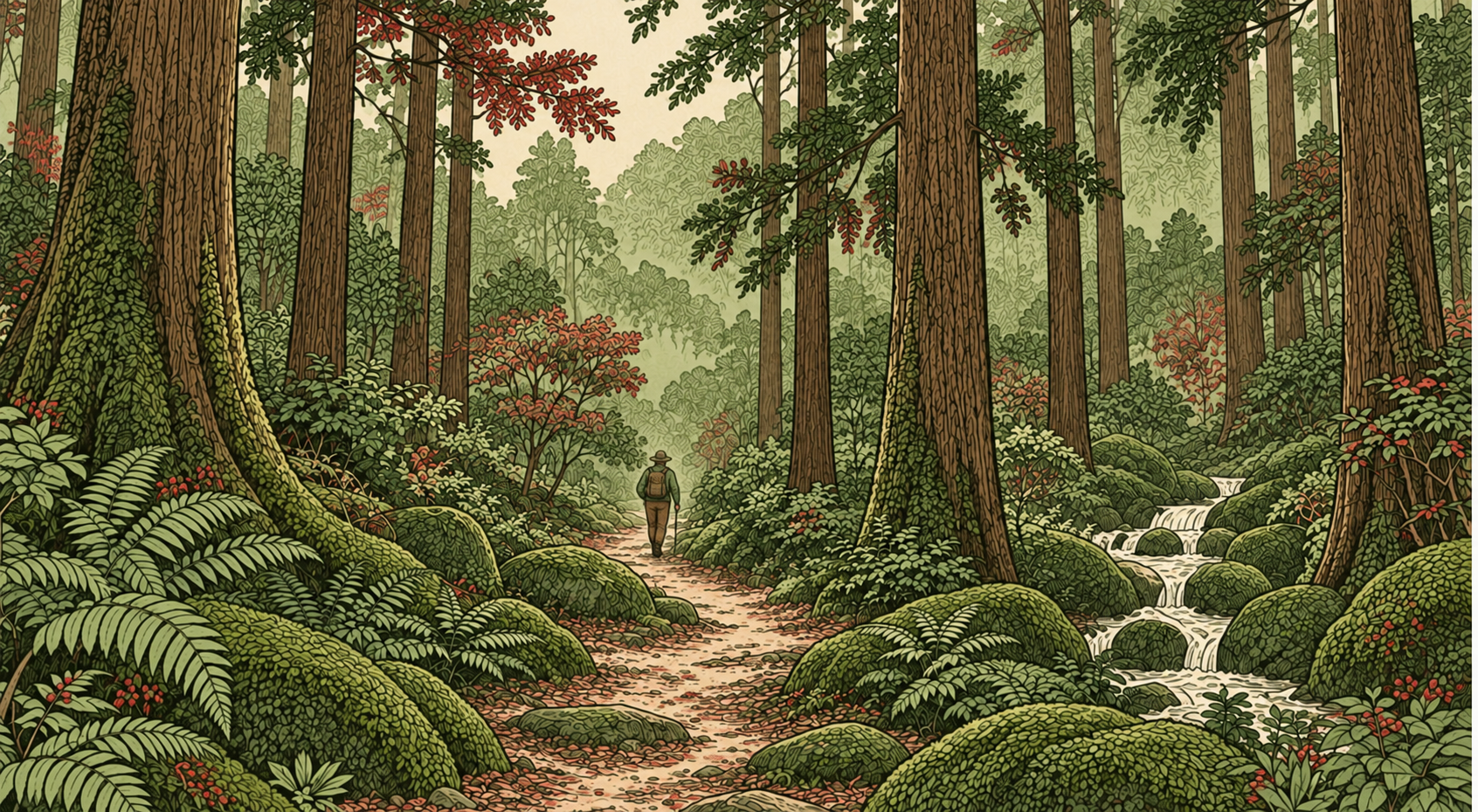
There is something restorative about stepping beneath a canopy of trees. The air feels cooler, everyday noise begins to fade, and the mind gradually settles into the quieter rhythm of the natural world. In Japan, this intentional immersion in nature is known as shinrin-yoku, or forest bathing.
Despite its name, forest bathing does not involve water. It means taking in the atmosphere of the forest through the senses. Unlike hiking, it is not focused on exercise, distance, or reaching a destination. The purpose is simply to slow down, become present, and reconnect with the natural environment.
RELATED ARTICLE: Nature’s Air Filters: The Science Behind Houseplants as Health Protectors
What Is Shinrin-Yoku?
The term shinrin-yoku combines the Japanese words for “forest” and “bathing.” The practice emerged in Japan during the early 1980s as a response to the stress, exhaustion, and disconnection associated with increasingly urban and technology-driven lifestyles.
Forest bathing invites us to experience nature without trying to accomplish anything. Instead of tracking steps or rushing toward a scenic overlook, participants move slowly, pause often, and notice what is happening around them.
It is closer to meditation than hiking. The forest becomes a place to practice attention.
The Benefits of Forest Bathing
Researchers have studied how spending intentional time in forests may affect the body and mind. Evidence suggests that forest bathing can help reduce stress, ease symptoms of anxiety and depression, and improve overall mood. One analysis of 36 studies involving more than 3,500 participants found meaningful improvements in anxiety and depressive symptoms, although the physiological evidence was less consistent.
Forest environments have also been associated with lower cortisol levels, the hormone commonly used as a marker of stress. A review and meta-analysis found that cortisol levels were generally lower following forest exposure than after time spent in urban environments, although researchers noted that more high-quality research is still needed.
“I went to the woods because I wished to live deliberately.”
Henry David Thoreau
In field experiments conducted across 24 Japanese forests, participants experienced lower cortisol concentrations, pulse rates, and blood pressure while spending time in forest settings compared with city environments. Their bodies also showed signs of greater parasympathetic activity—the “rest and restore” side of the nervous system.
In other words, time among trees may help the body shift out of a heightened stress response and into a calmer state.
Forest bathing should not replace medical or mental-health treatment, but it can be a gentle and accessible addition to a broader wellness routine.
RELATED ARTICLE: The Healing Power of Nature Bathing: Reconnecting with the Natural World
Why Forests Feel So Restorative
Part of forest bathing’s appeal lies in the way nature engages the senses without overwhelming them. Leaves move softly in the wind. Light filters through branches. Birds call from a distance. The ground changes beneath each step.
These details hold our attention differently than phones, traffic, notifications, and crowded schedules. We are alert, but not necessarily strained.
Trees also release aromatic compounds called phytoncides as part of their natural defense systems. Researchers continue to investigate whether breathing these compounds contributes to some of the immune and stress-related effects associated with forest environments. The findings are promising, but many of these possible benefits still require further study.
The clearest value may also be the simplest: a forest gives us permission to pause.
How to Practice Forest Bathing
You do not need special training, equipment, or an untouched wilderness. A wooded trail, botanical garden, quiet park, or tree-filled neighborhood can provide a place to begin.
Set aside at least 20 minutes, although an hour or two will allow you to settle more deeply into the experience. Silence your phone and leave headphones behind. Walk slowly without setting a distance goal.
As you move, bring your attention to each sense:
- Notice the shapes, colors, shadows, and movement around you.
- Listen for birds, rustling leaves, water, or distant wind.
- Feel the temperature of the air and the texture of bark or stone.
- Breathe in the scent of soil, trees, plants, and rain.
- Observe how your body feels without trying to change anything.

If you find a place that feels inviting, stop. Sit on a bench, lean against a tree, or stand quietly for several minutes. Let your attention rest on one small detail: a patch of moss, the movement of a branch, or sunlight falling across the path.
There is no need to clear your mind. When thoughts arise, acknowledge them and gently return your attention to what you can see, hear, smell, and feel.
Bringing the Practice Into Everyday Life
Forest bathing is not about escaping life. It is about returning to it with a little more space inside you.
Even brief encounters with nature can become small rituals. Drink your morning coffee beneath a tree. Walk through a nearby park after work. Sit outside without bringing your phone. Notice the changing light, weather, and seasons.
The Japanese practice of shinrin-yoku reminds us that wellness does not always require another product, program, or measure of progress. Sometimes it begins by slowing down long enough to notice the world that has been quietly living around us all along.
GET THOUGHTFUL MAIL TO LOOK FORWARD TO: The Goodie Letter Club