

The Tetrabiblos, written by the renowned astronomer and astrologer Claudius Ptolemy, stands as one of the most influential works in the history of astrology. Compiled in the 2nd century CE, this four-part treatise encompasses Ptolemy’s comprehensive understanding of astrology, covering essential concepts, techniques, and interpretations. In this article, we embark on a journey to unravel the significance and lasting impact of the Tetrabiblos.
Ptolemy’s Life and Influence (100 CE – 170 CE)
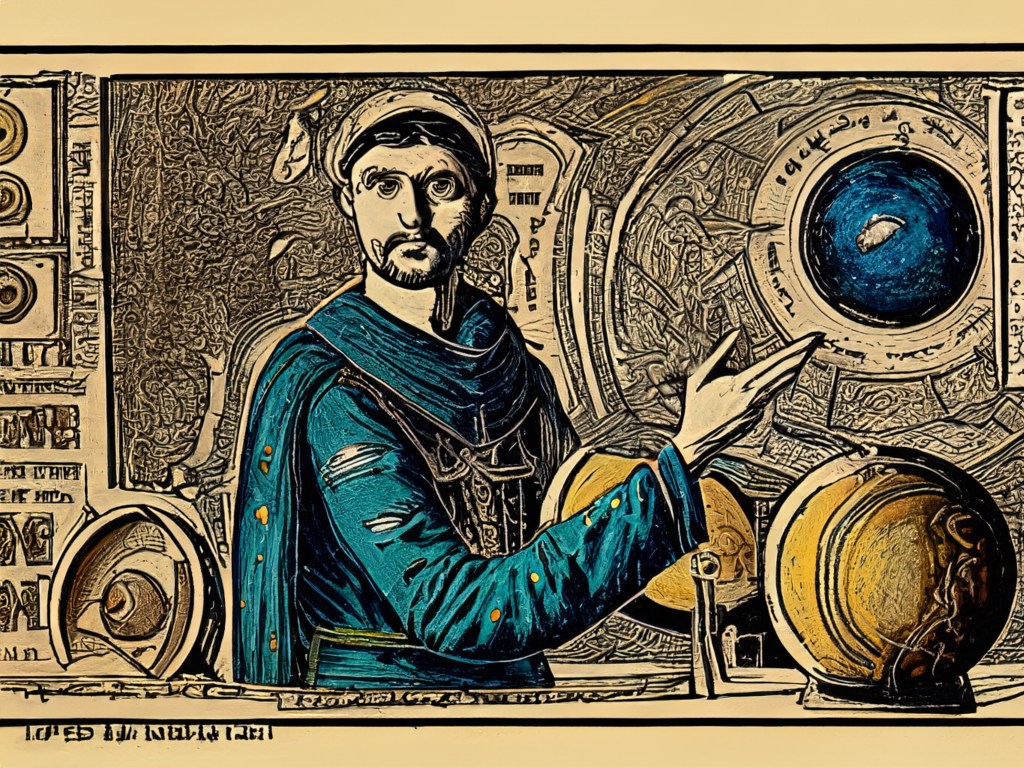
Ptolemy, born around 100 CE in Alexandria, Egypt, was a prominent figure in both astronomy and astrology. He combined the knowledge of Greek, Egyptian, and Babylonian astrological traditions in his work. Ptolemy’s contributions to astronomy, including his geocentric model of the universe, laid the groundwork for future scientific developments. His authority in astrology stemmed from his meticulous observations, calculations, and synthesis of astrological principles.
c. 100 CE: Claudius Ptolemy is born in the city of Ptolemais Hermiou in Roman Egypt.
150 CE: Ptolemy’s major work, “The Almagest,” is completed. It becomes a cornerstone in the field of astronomy.
150 CE: Ptolemy publishes “Geographia,” a comprehensive work on geography that includes maps and coordinates of known regions.
c. 150-160 CE: Ptolemy works on “Tetrabiblos,” a treatise on astrology, exploring the relationship between celestial bodies and human events.
c. 155-165 CE: Ptolemy writes “Optics,” a study on light and vision, discussing topics such as reflection and refraction.
c. 161 CE: Ptolemy compiles “Planetary Hypotheses,” presenting his geocentric model of the universe, which remains influential for centuries
c. 162 CE: Ptolemy publishes “Harmonics,” focusing on the mathematical principles of music, including scales and intervals.
c. 170 CE: Ptolemy likely passes away in Alexandria, Egypt.
The Structure of the Tetrabiblos
The Tetrabiblos, meaning “Four Books,” is divided into four parts, each addressing specific aspects of astrology.
- Book I focuses on the fundamental principles of astrology, including the influence of the planets, houses, and aspects.
- Book II explores the effects of celestial positions on human characteristics and temperaments.
- Book III delves into the analysis of nativities and predictions.
- Book IV discusses astrological techniques for delineating specific areas of life.
Essential Concepts and Techniques Explored in Tetrabiblos (2nd Century CE)

Ptolemy’s Tetrabiblos expounds upon crucial astrological concepts, such as the zodiac, planetary rulerships, and the significance of aspects. Ptolemy emphasizes the importance of accurate birth data and the interpretation of celestial positions in relation to specific life events. His treatise introduces techniques for analyzing planetary configurations, including the use of house systems, profections, and primary directions.
Influence and Enduring Legacy of The Tetrabiblos
The Tetrabiblos had a profound impact on the development and preservation of astrology. Ptolemy’s work was translated into Arabic during the Islamic Golden Age, and Arab scholars further expanded and refined its teachings. It became a cornerstone of medieval astrology in both the East and West, influencing astrologers like Abu Ma’shar and Guido Bonatti. Even during the Renaissance and Enlightenment periods, when astrology faced skepticism, the Tetrabiblos retained its authority.
Contemporary Significance and Criticism of The Tetrabiblos
Despite the advancements in scientific knowledge, the Tetrabiblos continues to be studied and appreciated by modern astrologers. Ptolemy’s emphasis on accurate observations, systematic analysis, and the psychological aspects of astrology resonates with contemporary practitioners. However, the Tetrabiblos has also faced criticism, particularly for its reliance on geocentric cosmology and its lack of acknowledgment of cultural and societal diversity.
Ptolemy’s Tetrabiblos remains a testament to the enduring influence of ancient astrological knowledge. Written in the 2nd century CE, this four-part treatise provides valuable insights into the foundations of astrology. Its structured approach, comprehensive coverage of astrological principles, and emphasis on accurate observations have ensured its relevance across centuries. As astrology continues to evolve and adapt, the Tetrabiblos serves as a timeless reference, bridging the gap between ancient wisdom and contemporary practice.
 GOODIE LIVING